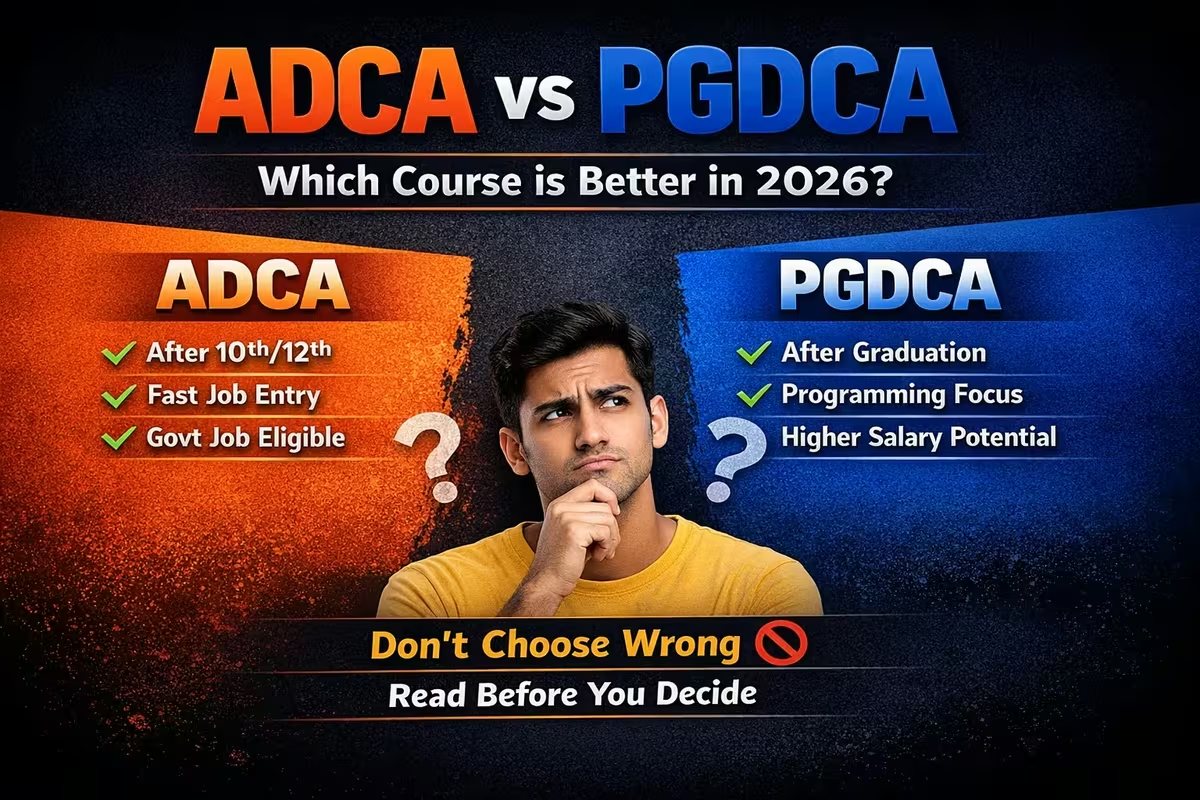
Short answer: ADCA (Advanced Diploma in Computer Applications) is better for students after 10th or 12th grade who want quick job placement, government job eligibility, and AI-integrated skills. PGDCA (Post Graduate Diploma in Computer Applications) is better for graduates who already hold a degree and want advanced programming or higher-level IT roles.
📋 In This Article
- What is ADCA and PGDCA?
- Full Side-by-Side Comparison Table
- Job Scope & Career Options
- Salary After ADCA vs PGDCA
- Who Should Choose Which?
- Frequently Asked Questions
- Conclusion & Our Recommendation
What is ADCA? What is PGDCA? (Quick Definitions)
Both are popular one-year computer diplomas in India, but they serve very different student profiles. Understanding the core difference helps you make the right decision before investing a year of your time.
What is ADCA?
ADCA (Advanced Diploma in Computer Applications) is a 12-month vocational IT diploma designed for students who have completed 10th or 12th grade. It covers MS Office, internet applications,data management, and increasingly — AI tools and cybersecurity basics. It is the most popular entry-level computer diploma in India because of its wide job eligibility and low entry requirement.
What is PGDCA?
PGDCA (Post Graduate Diploma in Computer Applications) is also a 12-month diploma, but it is classified as a post-graduate level course — meaning you must hold a graduation degree (B.A., B.Sc., B.Com., etc.) to enroll. PGDCA goes deeper into programming languages like C++, Java, database management (Oracle/MySQL), and systems analysis. It is suited for graduates who want to transition into software development or higher-level IT roles.
ADCA vs PGDCA: Full Side-by-Side Comparison (2026)
| Factor | 🟠 ADCA | 🔵 PGDCA |
|---|---|---|
| Full Form | Advanced Diploma in Computer Applications | Post Graduate Diploma in Computer Applications |
| Minimum Eligibility | 10th Pass (Matriculation) (Lower Barrier) | Graduation Degree Required |
| Duration | 12 Months | 12 Months |
| Level | Vocational / Diploma | Post Graduate Diploma |
| Average Course Fee | ₹8,000 – ₹25,000 (More Affordable) | ₹15,000 – ₹60,000 |
| Core Subjects | MS Office, Internet, AI Tools, Data Entry, Cybersecurity basics | C++, Java, DBMS, OS, Web Tech, Software Engineering (More Technical) |
| AI Tools Coverage | ✅ Yes (at HCI — ChatGPT, Canva AI, Generative AI) | ❌ Not standard — depends on institute |
| Government Job Validity | ✅ Yes — valid for state & central govt jobs (from recognized institutes) (Key Advantage) | ✅ Yes — but requires graduation first |
| Private Sector Jobs | Data entry, Computer operator, Office assistant, Accounts executive | Software developer, DBA, System analyst, IT executive (Higher Roles) |
| Starting Salary Range | ₹12,000 – ₹25,000/month | ₹18,000 – ₹40,000/month (Higher Start) |
| Best Suited For | Students after 10th/12th, job seekers, career changers | Graduates wanting IT career transition |
| Time to Enter Job Market | After 10th + 1 year = as young as 16–17 (Faster) | After graduation + 1 year = typically 22+ |
| Online Mode Available | ✅ Yes (at HCI — hybrid mode) | ⚠️ Limited |
| Placement Support | ✅ 100% at Hindustan Computer Institute | Varies by institute |
| ISO Certified Option | ✅ Hindustan Computer Institute is ISO 9001:2015 Certified | Varies by institute |
Job Scope After ADCA vs PGDCA
Career opportunities are the most important factor when choosing between these two diplomas. Both open real doors — but to different rooms.
Jobs After ADCA (2026)
ADCA graduates are in demand across government offices, private companies, schools, hospitals, NGOs, and retail businesses. Because most Indian offices still run on MS Office, and basic data management — ADCA skills remain highly employable.Job Role Sector Avg. Monthly Salary Data Entry Operator Government / Private ₹12,000 – ₹18,000 Computer Operator Government / MNC ₹14,000 – ₹22,000 Office Assistant Corporate / NGO ₹12,000 – ₹20,000 DTP Operator Printing / Media ₹12,000 – ₹20,000 IT Assistant (Govt) State/Central Govt ₹18,000 – ₹35,000 AI Tools Assistant Startups / SMEs ₹18,000 – ₹32,000
Jobs After PGDCA (2026)
PGDCA opens doors to more technical, higher-paying roles — but requires the additional foundation of a graduation degree. The job scope is narrower but deeper in the IT sector.Job Role Sector Avg. Monthly Salary Junior Software Developer IT Companies ₹20,000 – ₹45,000 Database Administrator Banking / Finance ₹22,000 – ₹50,000 Web Developer IT / Freelance ₹18,000 – ₹40,000 System Analyst MNCs ₹25,000 – ₹55,000 IT Support Executive Corporate ₹18,000 – ₹35,000
💡 HCI Advantage: Hindustan Computer Institute's ADCA course now includes AI tools training (ChatGPT, Canva AI, Generative AI) — making graduates competitive for newer roles in AI-assisted office work, content creation, and digital operations that most traditional ADCA or PGDCA programs do not cover.
Salary After ADCA vs PGDCA: Real Numbers (2026)
Salary depends on your institute's reputation, location, additional skills, and whether you get placement support. Below are realistic salary ranges based on current Indian job market data from Naukri and Glassdoor.
- ₹12K–₹25K: ADCA Fresher — First Job (Data Entry / Computer Operator / Accounts)
- ₹35K–₹50K: ADCA — 3 Years Experience (Senior Accounts / IT Assistant / AI Tools Specialist)
- ₹18K–₹40K: PGDCA Fresher — First Job (Junior Developer / DBA / Web Developer)
- ₹50K–₹80K: PGDCA — 3 Years Experience (Software Engineer / System Analyst / IT Manager)
While PGDCA leads to higher salaries in the long run, remember that ADCA students enter the workforce 3–5 years earlier (since they don't need a graduation degree first). This head-start in earning and experience often balances out the salary gap.
Who Should Choose ADCA? Who Should Choose PGDCA?
🟠 Choose ADCA if you are…
- A student who has completed 10th or 12th grade
- Looking for quick entry into the job market
- Interested in government job eligibility
- Looking for affordable, practical training
- Interested in AI tools for office and business use
- A working professional seeking a career upgrade
- Located in a Tier 2/3 city where practical skills are in demand
🔵 Choose PGDCA if you are…
- A graduate (B.A., B.Sc., B.Com., BCA, etc.)
- Interested in programming and software development
- Targeting IT companies like TCS, Wipro, Infosys
- Comfortable with technical subjects like C++, Java, DBMS
- Looking for higher initial salary in private IT sector
- Planning to pursue MCA or higher IT education later
- Already working in IT and need a formal qualification
Bottom line: If you haven't graduated yet — ADCA is the clear winner. It gets you employed faster, at a lower cost, with government job eligibility. If you already hold a degree and want a technical IT career — PGDCA adds genuine value.
Conclusion: ADCA vs PGDCA — Our Final Verdict (2026)
The "ADCA vs PGDCA which is better" debate ultimately comes down to where you are right now. The table below gives you a fast final answer:Your Situation Best Choice Completed 10th or 12th, want to start earning soon ADCA ✓ Want government job eligibility without a degree ADCA ✓ Want AI tools training included in course ADCA at HCI✓ Already have a degree, want to become a software developer PGDCA ✓ Want to work at IT companies like TCS or Wipro PGDCA ✓
For the majority of students in India — especially those from Jammu & Kashmir, J&K, and other Tier 2 and Tier 3 cities — ADCA from a quality, recognized institute gives you the best return on your time and money in 2026.
✦ Enroll in Hindustan Computer Institute's AI-Integrated ADCA Course
Get India's most job-ready ADCA diploma — ISO certified, government-valid, AI-integrated, with 100% placement support. Offline & online batches open for 2026.
- ✅ ISO 9001:2015 Certified
- ✅ Govt. of India Registered
- ✅ 100% Placement
- ✅ Online & Offline Modes
Or call us: +91 9419191044 · Admissions open for 2026 batch