Best Computer Course After 12th – What Actually Works in 2026?
Finishing 12th feels like a big deal. And then suddenly everyone around you is asking — "aage kya karoge?" — and you realize you have no clear answer.
Some friends go for B.A. Some join B.Com. A few just pick whatever sounds decent and hope for the best. And a lot of students quietly enroll in some basic computer course thinking it'll open doors.
Here's what nobody tells you upfront: knowing how to type and open MS Word is not a skill anymore. Every employer takes that as a given. If that's all your course taught you, you're not ahead — you're just average.
The question worth asking isn't "which computer course should I do after 12th?" The better question is: "which course will actually make me employable within the next year or so?"
There's a real difference. Let's talk about it honestly.
Where Most Students Get It Wrong
A lot of 12th pass students carry certain beliefs that sound reasonable but don't hold up in real life:
"Any computer course will do." "My degree is enough." "If I know Excel and Tally, I'll find a job." "AI is only for people doing engineering."
The problem is that companies don't hire certificates. They hire people who can actually do the work. And doing the work in 2026 means knowing software, understanding real workflows, and being comfortable with the tools modern offices use every day — including AI-based ones.
If your course skipped all of that, the certificate on your wall won't help much.
Three Courses Worth Your Time (and Money)
At Hindustan Computer Institute, the focus has always been on teaching skills that have actual demand — not just software names on a brochure. Here are the three strongest options for students after 12th:
1. AI Integrated ADCA – Advanced Diploma in Computer Applications
This one works well for students from any stream — Arts, Commerce, Science — who want to build a career in office jobs, data handling, or administration.
What you actually learn here goes well beyond the basics. You get into Excel properly — formulas, Pivot Tables, building dashboards. You learn Word and PowerPoint at a professional level, not just how to type and add a bullet point. Tally with GST is covered, along with email communication, basic networking, computer troubleshooting, and cybersecurity fundamentals.
And then there's the AI part — which a lot of students assume means writing code. It doesn't. It means learning to use tools like ChatGPT for drafting reports, automating repetitive Excel work, building better presentations in less time, and generally working smarter in a modern office environment.
After completing this course, students typically go into roles like Data Entry Operator, Office Executive, MIS Executive, Back Office Coordinator, or Junior Data Analyst at the entry level.
Salary for freshers in India usually falls somewhere between ₹12,000 and ₹25,000 a month. The gap between those two numbers comes down to how deep your Excel skills are and whether you actually practiced or just attended classes.
2. AI Integrated ADFA – Advanced Diploma in Financial Accounting
This one is built for students who are drawn toward accounts and finance — especially those from a Commerce background, though it's open to others too.
The course covers Tally Prime with GST in real depth, not just theory. You practice actual accounting entries, learn inventory management, work through taxation basics, and get comfortable with financial reporting. Excel here is specifically for accounting work — tracking vendor payments, processing salaries, generating reports.
What's different from most accounting courses is the focus on workflow. Students at HCI practice creating invoices, simulating GST returns, and working through real business case studies — the kind of situations you'll actually face in a job on day one.
Roles after ADFA include Accountant, Billing Executive, GST Assistant, Accounts Executive, and similar positions. With GST compliance continuing to grow in India, people who actually understand this work are consistently in demand.
Salary expectations: ₹15,000 to ₹30,000 a month, again depending on skill depth.
3. AI Integrated MDCAA – Master Diploma in Computer Applications & Accounting
If the first two courses are good, this one is for students who want to be seriously prepared — not just for one type of job, but for a range of opportunities.
MDCAA brings together everything from ADCA and ADFA — computer applications, accounting, Excel, AI tools, cybersecurity basics — and adds soft skill training and interview preparation on top of it.
Think of it this way: ADCA builds your foundation. ADFA builds your specialization. MDCAA builds the kind of profile that gives you options — whether you end up in operations, finance, administration, or a mix of all three.
It's the right choice if you want stronger earning potential and don't want to limit yourself to just one type of role.
Why the AI Part Actually Matters
Let's not dance around it. AI is changing how work gets done — not just in big companies, but in small offices, local businesses, everywhere.
It's not going to replace someone who knows their job well. But it will absolutely replace someone who is slow, refuses to learn new tools, and does things the long way when a faster method exists.
Most offices today use some form of AI-assisted documentation, automated billing, or Excel automation. If you walk in knowing how to combine domain knowledge with these tools, you're valuable. If you've never touched any of it, you're already behind on day one.
That's just the reality right now.
A Simple Comparison That Makes the Point
Picture two students. Same city, same 12th pass qualification, same year of graduation.
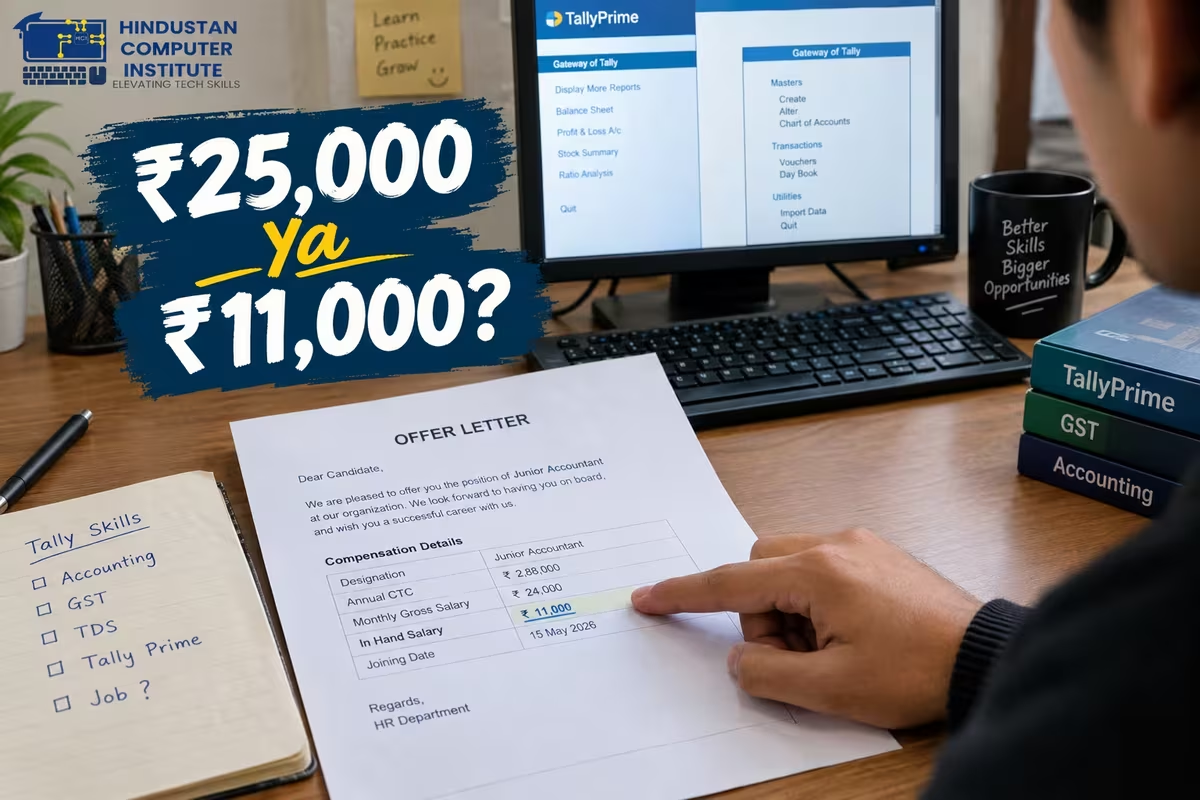
Student A learned basic Excel, didn't go deep on formulas, never touched GST, never used AI tools. Landed a job at ₹12,000 a month.
Student B put in the time on Excel dashboards, practiced accounting entries, understood GST basics, got comfortable with AI tools for reporting. Got placed at ₹24,000 a month.
Nobody gave Student B extra marks for their degree. The difference was entirely in what they could actually do.
Mistakes That Are Easy to Avoid (But Many Still Make)
Picking a 3-month course just because it's quick and cheap. Skipping Excel because it looks boring. Avoiding accounting because "maths weak hai" — even though accounting software does most of the calculation. Assuming AI is someone else's problem. Not working on how you communicate, just collecting certificates.
A focused 6-month course where you actually build skills will do more for your career than 3 years of doing something half-heartedly.
What Companies Actually Expect vs. What Students Think
This gap is why people struggle to find jobs even when jobs exist.
Questions to Ask Before Joining Any Course
Before you pay fees anywhere, get honest answers to these:
Does the course include AI tools or just traditional software? Is Excel taught beyond the basics? Is there real accounting practice with GST? Are case studies and projects part of the curriculum? Is interview preparation included?
If most answers are no — look elsewhere.
About Hindustan Computer Institute
HCI is ISO 9001:2015 certified and has kept a consistent focus on job-oriented training rather than just issuing diplomas. The approach here is practical-first — small batches, real simulations, Excel specialization, soft skill training, and a curriculum built around what offices actually need today.
Where the Market Is Heading (2026–2028)
Small businesses across India are digitizing fast. GST compliance work keeps growing. Data handling roles are increasing across industries. AI-based documentation is quickly becoming normal rather than special. Excel-based reporting is expected in almost every office role.
What that means practically: someone who combines computer skills, accounting knowledge, and basic AI fluency has a stable, growing set of options ahead of them. Someone with just a degree and no practical skills is going to have a harder time.
Straight Advice, No Fluff
After 12th, don't pick a course because the name sounds impressive or because your neighbor is doing it. Pick based on where you want to work and what skills will get you there.
Want office and admin roles? ADCA is your path. Want accounts and finance? ADFA is the better fit. Want more flexibility and a stronger overall profile? MDCAA gives you that.
Whatever you choose — choose seriously. Skills build on each other over time. Waiting or doing something random doesn't just waste money, it wastes the months when you could have been getting ahead.