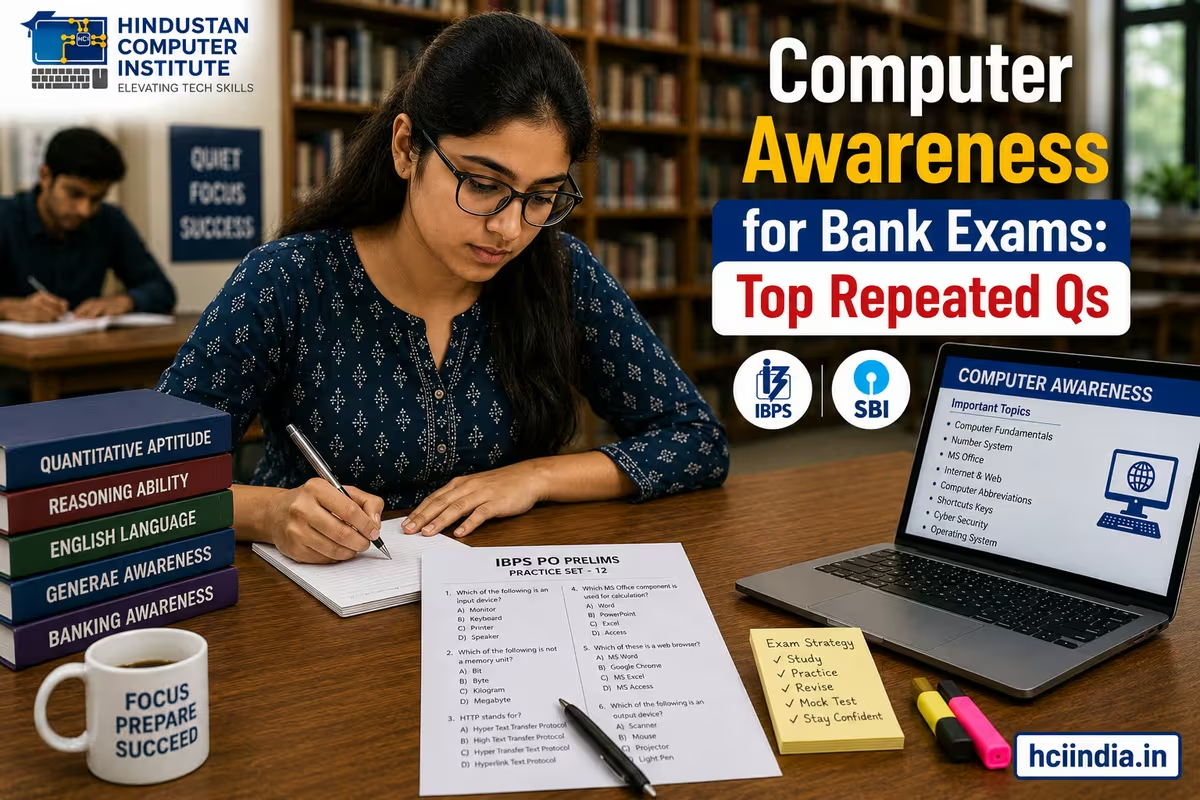
Computer awareness for bank exams is one of the easiest sections to score in, because the same questions repeat across IBPS, SBI, and RRB papers year after year. Master high-frequency topics like computer fundamentals, memory, MS Office, networking, and banking-related tech, and you can lock in quick marks with little effort. Below is a curated practice set of the most repeated question types.
Why Focus on Computer Awareness Bank Exam Questions? (Quick Answer)
Computer awareness bank exam questions are high-scoring because they're factual, predictable, and time-efficient - you don't need calculations, just recall. In IBPS and SBI exams, this section can add several near-guaranteed marks if you've revised the repeated topics. Since the syllabus is stable, a focused revision plan beats last-minute cramming. The trick is knowing which topics and question styles keep coming back.
Most Repeated Topics and Sample Questions
| # | Question | Answer |
|---|---|---|
| 1 | Full form of CPU | Central Processing Unit |
| 2 | Full form of RAM | Random Access Memory |
| 3 | Brain of the computer | CPU |
| 4 | Full form of ROM | Read Only Memory |
| 5 | Shortcut to copy | Ctrl + C |
| 6 | Shortcut to paste | Ctrl + V |
| 7 | Full form of URL | Uniform Resource Locator |
| 8 | Full form of HTTP | HyperText Transfer Protocol |
| 9 | 1 Byte equals | 8 bits |
| 10 | MS Excel is used for | Spreadsheets and calculations |
| 11 | Full form of PDF | Portable Document Format |
| 12 | Father of the computer | Charles Babbage |
| 13 | Full form of LAN | Local Area Network |
| 14 | Volatile memory | RAM |
| 15 | Full form of IP | Internet Protocol |
| 16 | Shortcut to save | Ctrl + S |
| 17 | Full form of GUI | Graphical User Interface |
| 18 | Full form of ATM | Automated Teller Machine |
| 19 | Full form of IFSC | Indian Financial System Code |
| 20 | Full form of NEFT | National Electronic Funds Transfer |
Banking-Focused Computer Questions to Master
Here's the part most aspirants miss: bank exams love computer questions with a banking angle, so don't skip them. Know the full forms and basics of NEFT, RTGS, IMPS, UPI, IFSC, MICR, and CTS, because these bridge computer awareness and banking awareness and appear often. Understand what a core banking solution (CBS) is, the difference between debit and credit cards, and simple cyber-safety terms like phishing, OTP, and firewall. In our exam-prep sessions, students who group these banking-tech terms into one revision sheet remember them far better than studying them scattered. Add another 30 questions of this style to the table above, and you'll have covered most of what IBPS and SBI repeat.
How to Revise for Maximum Marks
The smartest approach is short, spaced revision rather than one long sitting. Make a single sheet of high-frequency facts - full forms, shortcut keys, memory types, and banking-tech terms - and revise it daily for a few minutes. Take a 20-question quiz twice a week to test recall under mild time pressure, since speed matters in the real exam. Focus your energy on the repeated topics above rather than obscure trivia, because exam setters reuse the reliable ones. Pairing this with hands-on MS Office familiarity, which you can build through a Basic Computer Course, makes the practical questions almost automatic. Consistency, not volume, wins this section.
Why Prepare With Hindustan Computer Institute?
Hindustan Computer Institute is ISO 9001:2015 certified, and we help bank-exam aspirants turn computer awareness into guaranteed marks. Our preparation combines a strong computer foundation with topic-wise quizzes on the most repeated IBPS and SBI questions. We run offline and online batches across J&K, so students from smaller towns can prepare with support. With 2,500+ students trained, our focus is efficient, targeted practice that fits alongside your other bank-exam subjects.
Conclusion
Computer awareness for bank exams is easy, repeatable marks if you revise the right questions: full forms, shortcuts, memory types, and banking-tech terms like NEFT and IFSC. Build a high-frequency question bank, quiz yourself twice a week, and this section becomes a strength. Want structured bank-exam computer practice? Call or visit your nearest HCI center, or book a free counselling session.