After completing a computer diploma, data entry operator is one of the most accessible first jobs available to freshers in India. Entry salaries range from ₹9,000 to ₹18,000 per month in Tier-2/3 cities, rising to ₹20,000–₹30,000 with 2–3 years of experience. Government offices, hospitals, logistics firms, BPO companies, and banks are among the most active hirers.
Data Entry Job Roles After Computer Diploma: What's Actually Available
The phrase "data entry job" covers more ground than most freshers realise. Here is a breakdown of the specific roles that open up after a computer diploma, what each one involves day-to-day, and what it pays at the entry level:Job Role Core Work Entry Salary (per month) Key Sectors Data Entry Operator Typing records into databases, Excel sheets, or ERP systems ₹9,000 – ₹15,000 Government offices, hospitals, NGOs Back Office Executive Document processing, data verification, MIS reports ₹12,000 – ₹18,000 Banks, NBFCs, insurance companies BPO / KPO Data Processor Order entry, claims processing, form digitisation ₹12,000 – ₹22,000 BPO firms, IT-enabled services MIS Executive (Junior) Excel-based reporting, pivot tables, data summaries ₹14,000 – ₹22,000 Manufacturing, logistics, retail chains Computer Operator (Govt) Data entry in govt portals, file management, typing work ₹18,000 – ₹30,000 (fixed pay) Central and state government offices Billing / Invoicing Clerk Entering invoices and purchase orders in Tally or ERP ₹10,000 – ₹16,000 Trading companies, pharma distributors Medical Records Executive Digitising patient records, coding, hospital software ₹11,000 – ₹18,000 Private hospitals, diagnostic labs
Salaries above reflect typical ranges for Tier-2/3 Indian cities including Jammu, Pathankot, Kathua, and similar markets. The same roles in Delhi, Noida, or Bengaluru generally pay 25–40% higher at the entry level.
What Skills Employers Check Before Hiring a Data Entry Fresher
Here is the part most computer diploma students find out only after their first interview: employers are not looking at your certificate first. They are testing whether you can actually sit at a computer and work.
The baseline requirement for any data entry job is a typing speed of at least 30–35 words per minute with reasonable accuracy. Below that threshold, most employers will not shortlist you, no matter how good your diploma looks on paper. In competitive government recruitment - SSC CHSL, JKSSB Computer Operator posts, or Railway data entry roles - the cut-off is typically 35 WPM in English or 25–30 WPM in Hindi. Speed matters. Accuracy matters slightly more.
Beyond typing, MS Excel is the skill that separates a ₹10,000 data entry job from a ₹18,000 MIS or back-office role. Specifically: the ability to filter large datasets, use VLOOKUP and basic formulas, and build a simple pivot table. You do not need advanced Excel for most entry-level roles. But you need to be comfortable enough that a manager can hand you a raw spreadsheet and trust you to sort it out.
The third skill most freshers overlook is working inside a software system - whether that is Tally Prime for an accounting firm, a hospital management system, or a CRM tool like Zoho or HubSpot. The specific software matters less than the ability to learn a new interface quickly and work without constant supervision. Employers test this during the trial week.
At HCI, the ADCA course covers MS Office (including Excel), internet tools, and basic data management across 12 months - with regular practice on live systems rather than just textbook exercises. Students who complete the full programme typically meet the typing and Excel requirements employers check before offering a job.
Wondering which course gives you the fastest route to a data entry or back-office job?
HCI's ADCA and DCA courses cover typing, MS Excel, and the computer skills employers actually check at interview. Book a free counselling session - we'll tell you exactly which batch fits your schedule and background.
Is a Data Entry Job After Computer Diploma Worth It in 2026?
This is the question students ask most, and it deserves a straight answer rather than a cheerful non-answer.
Data entry as a career ceiling is real. If you spend five years doing pure copy-paste work and nothing else, the salary growth is modest and the job security is genuinely at risk from automation. Routine form-filling and document digitisation are the kinds of tasks where software tools are already replacing human operators in large companies.
But data entry as a starting point is a different story. Most students who take a data entry role after their computer diploma are not planning to do that exact job forever. They are buying time, building experience on a live system, and looking for the next move. And that next move is usually available faster than people expect.
A data entry operator who learns Excel properly - pivot tables, VLOOKUP, conditional formatting - can move into an MIS executive role within 18–24 months. That role pays ₹18,000–₹30,000 in most Tier-2 cities and has significantly better job security because it requires judgment, not just speed. From there, the path to operations analyst, accounts executive, or even a junior HR role is a matter of picking up one more skill set.
The students who get stuck are the ones who stay purely in typing work. The ones who move forward are the ones who treat the data entry job as a classroom - they learn the company's systems, understand how the data flows, ask questions, and build skills in the background.
Government Data Entry Operator Jobs: Eligibility and Scope After a Computer Diploma
For students in J&K, Himachal Pradesh, Punjab, and Uttarakhand, government data entry and computer operator posts are among the most sought-after outcomes after a computer diploma - and for good reason. Fixed pay, job security, and state benefits make these roles genuinely worth pursuing.
At the central government level, SSC CHSL (Staff Selection Commission Combined Higher Secondary Level) is the primary recruitment exam for Lower Division Clerk and Data Entry Operator posts. The DEO post under SSC CHSL requires Class 12 pass and a typing speed of 8,000 key depressions per hour on a computer. Most computer diploma holders comfortably meet the typing requirement - the challenge is the written examination, which tests general intelligence, English, and quantitative aptitude.
In J&K specifically, the JKSSB (Jammu and Kashmir Services Selection Board) regularly announces computer operator and data entry vacancies across departments. Posts under Divisional Cadre Jammu, health services, the revenue department, and the police department have come up in recent recruitment cycles. A computer diploma is typically listed as a required or preferred qualification, and candidates with a recognised diploma from an ISO-certified institute carry a stronger application.
Railway recruitment is another avenue. RRB (Railway Recruitment Board) announces Junior Time Keeper, Commercial Apprentice, and Junior Clerk-cum-Typist posts where computer proficiency and typing speed are evaluated directly. The Genpact and Wipro BPO centres in Noida and Gurugram also recruit from Tier-2 cities actively, and HCI has placement partnerships with both firms for qualifying students.
For students aiming at government posts, the ADCA or the MDCAA dual diploma provides a stronger credential than a short DCA alone - both because of the duration and because ISO 9001:2015 certification on the institute means the qualification is formally recognised in application processes.
Data Entry Salary After Computer Diploma: Growth Over 5 Years
The first-year salary for a data entry fresher is honest but not exciting. The five-year picture is considerably better for anyone who builds skills deliberately along the way.Stage Typical Role Monthly Salary Range What Gets You There 0–1 year Data Entry Operator / Typist ₹9,000 – ₹15,000 Typing speed + basic Excel + diploma 1–2 years Back Office Executive / Billing Clerk ₹14,000 – ₹20,000 Software proficiency + accuracy track record 2–4 years MIS Executive / Office Coordinator ₹18,000 – ₹30,000 Advanced Excel + report-building skills 4–6 years Senior MIS / Operations Analyst ₹28,000 – ₹45,000 Dashboard tools + process knowledge Government DEO (any point) Data Entry Operator (Govt) ₹18,000 – ₹35,000 + DA/benefits SSC CHSL / JKSSB + typing clearance
One thing that consistently bumps the salary curve faster: adding Tally Prime or a basic accounting knowledge alongside data entry skills. A candidate who can enter data and reconcile accounts is filling two roles for one hire - which is exactly what most small and mid-size businesses want when they are budget-constrained. HCI's ADFA course covers this combination in depth.
Why Students from J&K and Punjab Choose HCI for Computer Diploma Training
HCI is an ISO 9001:2015 certified institute, MSME registered with the Government of India, and holds affiliations with Tally Solutions and Marg ERP - credentials that most local institutes in the Billawar, Kathua, and Pathankot belt cannot match. That distinction shows up practically in two ways: recognised certificates that hold up in government applications, and a curriculum that reflects what employers in 2026 are actually hiring for.
Our trainer Himani Sharma handles MS Office and computer applications training. Students in her batches regularly clear typing tests at 40+ WPM by the end of the first term, and the Excel module goes beyond textbook formula lists - students practice on real data sets of the kind they will encounter in a back-office or MIS role. We have trained over 2,500 students across all our courses, and our placement network includes active partnerships with TCS, Wipro, Genpact, and HCL for qualifying candidates.
For students in Billawar, Kathua, Udhampur, or across the Pathankot border in Punjab, offline batches at our campus mean hands-on practice in a real computer lab - not watching a recorded video and hoping the skill transfers. For students who cannot commute, online batches are available on the same curriculum.
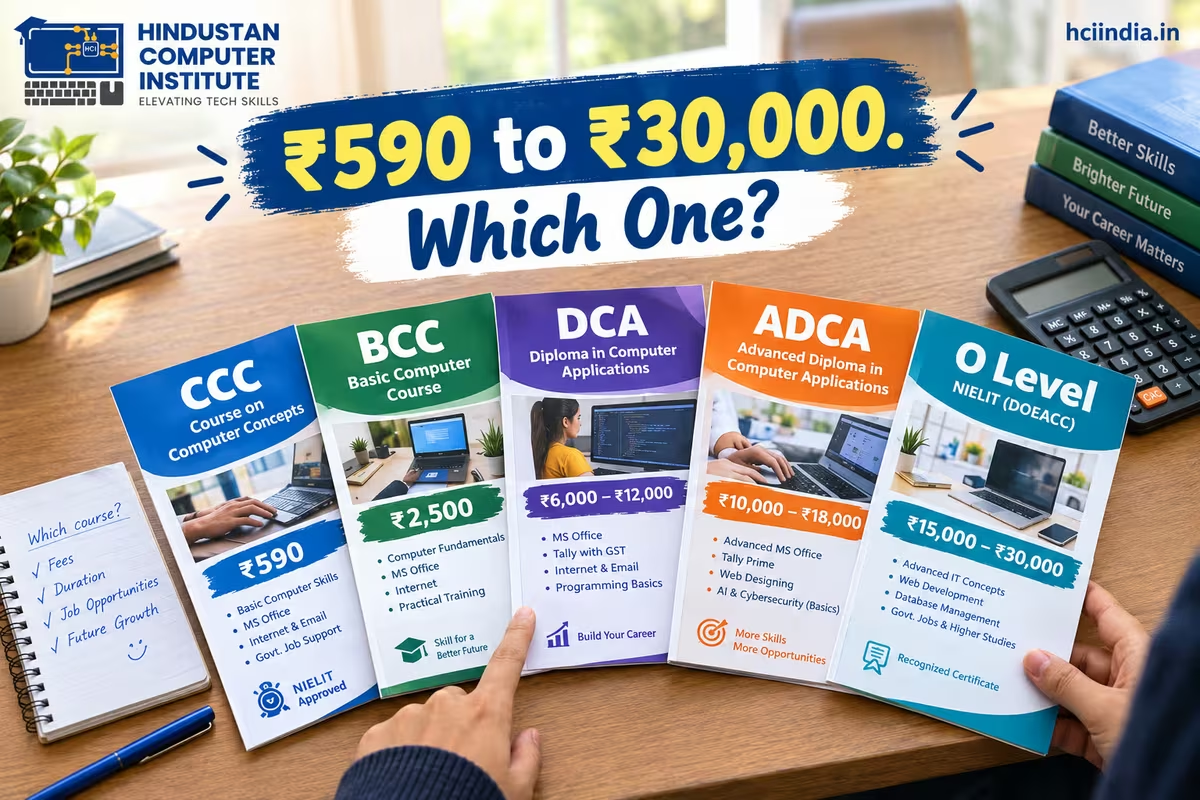
If you are deciding between a short DCA and a full 12-month ADCA, the honest difference is this: the DCA gets you to a data entry job. The ADCA gets you to that job and builds the Excel, accounting, and IT skills that determine where you end up two years later. For most students who come to us from Class 12, the extra months are worth it.
The Honest Case for Starting With a Data Entry Job After Your Computer Diploma
A data entry job is not the finish line. It is, for most freshers coming out of a computer diploma, a working starting point - a paying job that gets you inside a real office, onto a real system, and into the kind of routine where skills compound quickly if you pay attention.
The salary at the beginning is modest. That is simply true. But the difference between a ₹10,000 data entry operator at 21 and a ₹35,000 MIS executive at 26 is usually one thing: whether the person built Excel and software skills deliberately during those five years, or just typed the same records into the same fields every day.
Your diploma gives you the entry ticket. What you do with the time on the job determines the rest. If you want help picking the right course to get that first ticket - and to make sure the second and third doors are open when you need them - speak with a counsellor at HCI before you decide.
👉 Book a free counselling session at HCI - no forms, no pressure, just a straight conversation about which course fits your situation.
Author: Dinesh Sharma, Founder & CEO, Hindustan Computer Institute (ISO 9001:2015 Certified | Tally Authorized Training Partner | MSME Registered)
Last Updated: June 2026