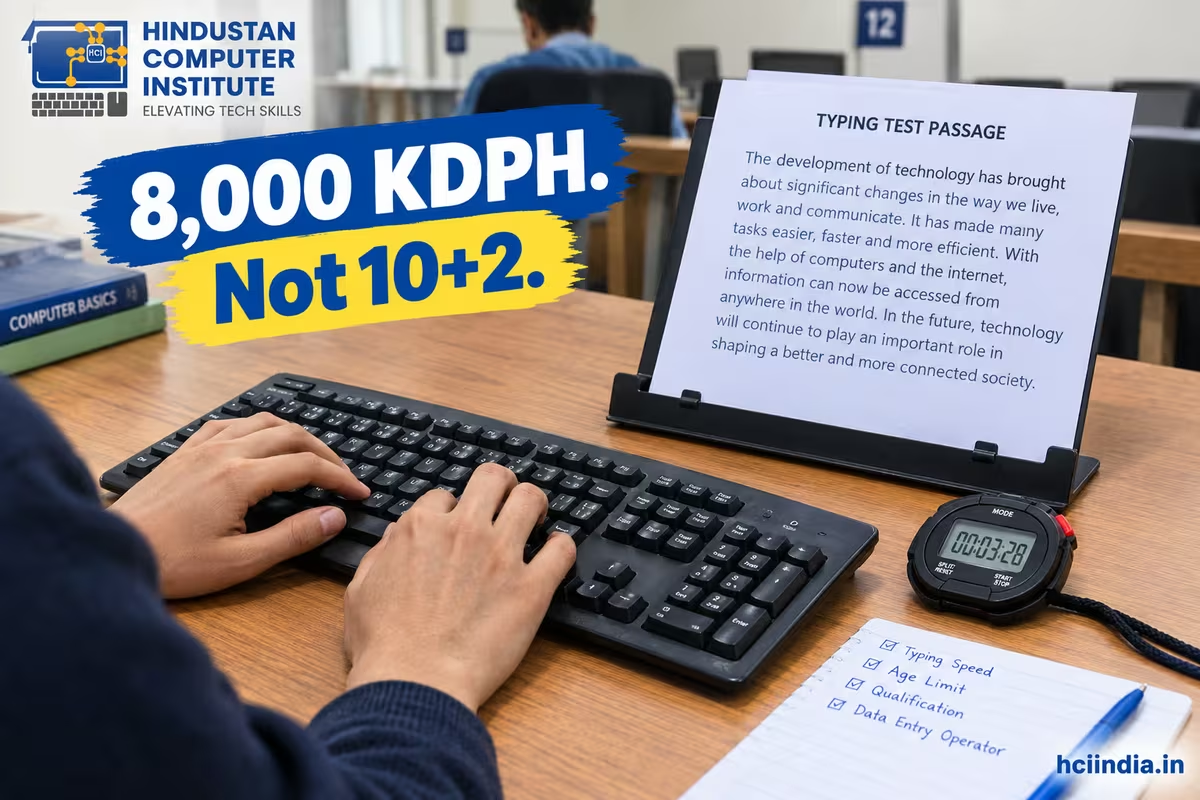
The basic data entry operator qualification is 10+2 or equivalent from a recognised board, with an age limit generally between 18 and 27 years and relaxations for reserved categories. The requirement that actually decides selection is the skill test: typically 8,000 key depressions per hour for central government DEO posts, tested on a computer under time.
What is the qualification for a data entry operator? (Quick Answer)
Educationally, very little. 10+2 in any stream is the standard bar, and some state and private roles accept Class 10 with a computer certificate. There is no degree requirement and no specific subject requirement.
That low bar is exactly why the skill test is where candidates are actually filtered. Anyone can meet the paperwork requirement. Far fewer can hit the speed with the accuracy required, and that is the part most people underprepare.
Data entry operator eligibility at a glance
| Requirement | Central govt (SSC CHSL DEO) | State and private roles |
|---|---|---|
| Education | 10+2 in any stream | 10+2, sometimes Class 10 with computer certificate |
| Age limit | 18–27 years | Usually 18–35, varies by state |
| Age relaxation | OBC +3, SC/ST +5, PwD +10 to +15 | As per state rules |
| Typing speed | 8,000 key depressions per hour | 25–35 WPM commonly specified |
| Computer certificate | Not always mandatory | CCC or equivalent frequently required |
| Selection | Tier-I CBT, Tier-II, skill test | Written test plus typing test |
Requirements vary between recruiting bodies [uncertain - always read the specific notification, since age limits, speed requirements and certificate conditions differ by post and by state].
Key depressions per hour, and why it confuses everyone
Government notifications express typing speed in key depressions per hour rather than words per minute, and the two are not the same measurement.
8,000 key depressions per hour works out to roughly 27 to 30 words per minute, taking the standard convention of five keystrokes per word. So a DEO requirement of 8,000 KDPH is broadly comparable to about 30 WPM sustained for the full test duration.
The word "sustained" is doing a lot of work in that sentence. Typing 30 WPM in a fifteen-second burst is not the same as holding it for the length of a test while reading unfamiliar text, and candidates who practise in short bursts consistently underperform on the day.
Some senior DEO grades specify considerably higher, up to 15,000 key depressions per hour, which is a genuinely demanding speed and requires proper touch-typing rather than fast hunt-and-peck.
Accuracy is the part that fails people
Speed gets discussed and accuracy decides outcomes. Most typing tests specify a minimum accuracy alongside the speed, commonly around 90 to 95 percent, and falling below it disqualifies you regardless of how fast you typed.
This produces a specific failure pattern we see every year in our batches. A student practises for speed, pushes to 40 WPM with 82 percent accuracy, walks into the test confident, and fails on errors while candidates typing 32 WPM cleanly pass comfortably.
The correct training order is accuracy first, then speed. Get to 98 percent accuracy at whatever slow speed that requires, and then increase pace gradually. Speed built on top of accuracy is stable. Accuracy retrofitted onto speed generally is not.
Which posts actually hire data entry operators
SSC CHSL is the largest and best-known route, recruiting DEOs alongside LDC and JSA posts across central government departments and ministries. Pay for a regularised central DEO post commonly works out to roughly ₹33,000 to ₹40,000 a month in hand depending on city classification [uncertain - depends on pay level, allowances and posting].
State-level recruitment runs continuously and varies enormously in scale and conditions. In J&K, JKSSB posts covering junior assistant and computer-side roles come up regularly, and those carry their own typing requirements. Our post on computer operator government jobs including JKSSB and SSC covers those in detail.
Private-sector data entry work is the easiest to enter and the least protected. Hospitals, transport companies, distributors, courier firms and back-office units hire continuously, usually at ₹8,000 to ₹16,000 a month for freshers [uncertain - varies widely and contractual arrangements are common].
One warning worth stating plainly: any "data entry job" advertised online that asks you to pay a registration fee is not a job. Genuine employers do not charge candidates. This scam runs constantly and targets exactly the people searching this topic.
How long it takes to reach the required speed
From zero, with honest daily practice of thirty to forty-five minutes, most people reach 30 WPM at good accuracy in about eight to twelve weeks. That is the realistic figure, not the one advertised on typing software.
The first two weeks feel like going backwards, because learning correct finger placement is slower than the hunt-and-peck method you already have. Students who push through that dip reach a far higher ceiling. Students who revert to two-finger typing plateau around 25 WPM and stay there permanently.
If you already type reasonably and need to get from 25 to 35 WPM, that is typically four to six weeks of focused work. Our 3-month professional typing course is built around that curve, with the first month spent almost entirely on accuracy and correct technique.
The qualification nobody lists but everyone wants
Read enough DEO job descriptions and a pattern emerges beyond the stated eligibility. Employers want someone who can work in Excel, not just type.
Pure keystroke work is genuinely shrinking as scanning, OCR and form automation improve. What is not shrinking is the need for someone who can take messy data, clean it, sort it, and produce something usable. That is a spreadsheet skill sitting on top of a typing skill.
Candidates who pair the typing speed with working Excel knowledge move out of data entry within a year or two rather than staying in it. Candidates who only type stay where they started. Worth knowing at the beginning rather than at year three.
Typing and computer training at HCI
Our typing course runs accuracy-first and tests on timed passages rather than familiar practice text, because typing a passage you have seen before measures memory rather than skill. Students preparing for government skill tests practise at the required speed with the required accuracy threshold, under time.
ISO 9001:2015 certified, MSME and Ministry of Corporate Affairs registered, 2,500+ students trained from Billawar, online batches available.
Conclusion
The paperwork requirement for a data entry operator is 10+2 and an age between 18 and 27 for central posts, and clearing that is the easy part. Build accuracy to 98 percent before you chase speed, practise on unfamiliar passages under time, and add Excel so the job becomes a starting point rather than a destination. And never pay a fee to apply for a data entry job. Come to our Billawar centre for a timed typing assessment, or book a free counselling session to see how far you are from the required speed.