Imagine coming into office on a Monday morning. You make your chai, open your laptop - and the AI agent you set up on Friday has already drafted the weekly status report, responded to three client emails, fixed a login bug in the staging environment, and generated the test cases for the new feature sprint.
You haven't typed a single line yet.
This is not a pitch for some future product. This is what GPT-5.4, OpenAI's latest model released this month, can already do. And if you work in IT in India - whether you're a fresher waiting for your first offer letter or a senior engineer at a Bengaluru product company - it's worth paying attention.
Not because your job is disappearing tomorrow. But because the profession is changing faster than most people are updating their resumes.
What Exactly Is GPT-5.4?
GPT-5.4 is OpenAI's newest large language model - but calling it a "chatbot" misses the point entirely. The version that's getting everyone talking isn't the one that answers your questions. It's the one that takes actions.
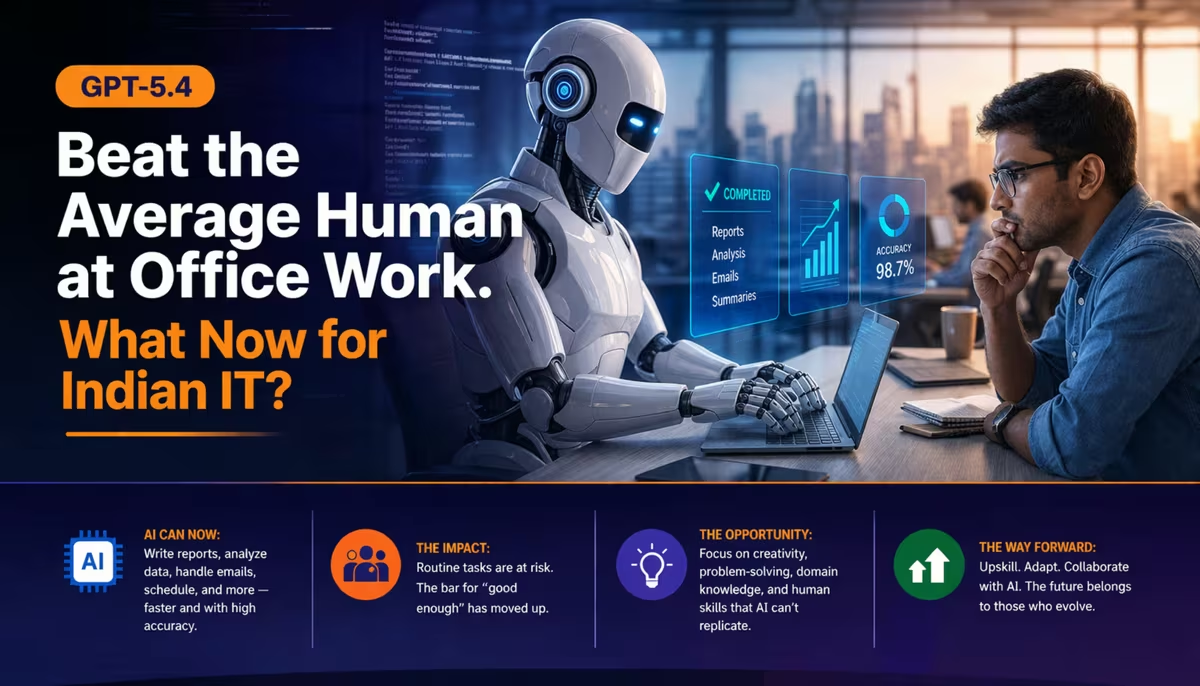
The model was tested on something called the OSWorld-V benchmark, which simulates real computer tasks: opening applications, filling out forms, writing and running code, navigating websites, managing files. It scored 75% on those tasks. The average human doing the same tasks scored 72.4%.
Read that again. The AI is slightly better than the average person at routine computer work.
It also comes with a 1-million token context window - meaning it can read and reason over an entire large codebase, a year's worth of project documentation, or hundreds of spreadsheet rows in a single session, without losing track of context.
The shift here is from AI as a tool you query to AI as an agent that works. Earlier models would help you write code if you asked. GPT-5.4 can be given a goal - "refactor the authentication module and write tests for it" - and figure out the steps itself.
Which Indian IT Jobs Are Most Affected?
This is the question everyone is actually asking. Let's be direct about it.
Jobs where the impact is real and immediate:
- Manual QA testing is the most obvious one. If an AI agent can read your codebase, understand what the application is supposed to do, write test cases, run them, and flag failures - a lot of the work that junior QA engineers do today gets absorbed. Not all of it. Edge cases, exploratory testing, and understanding what a confused user actually does with your product still needs a human. But the "write 50 regression test cases for this module" part? That's gone.
- L1 IT support - the helpdesk roles that handle password resets, access requests, and basic troubleshooting - is already being automated in large Indian IT services companies. GPT-5.4 accelerates this trend significantly.
- Data entry and report generation roles, which many BPO professionals in India depend on, are squarely in the firing line. If the task involves taking information from one place and putting it in another, an AI agent handles it faster and without errors.
- Basic boilerplate code writing - creating CRUD endpoints, writing standard API integrations, generating database migration scripts - is something junior developers currently spend real time on. That time is shrinking.
Jobs that are changing, not disappearing:
- Junior software developers are not going to be replaced. But the job is transforming. Instead of writing the first draft of code yourself, you'll increasingly review, correct, and direct code that an AI agent wrote. This requires a different skill set - you need to read code critically, catch subtle logic errors, and understand what correct output should look like. That's harder, not easier.
- Business analysts who gather requirements and write specifications are also in a transitional zone. AI can help structure and document requirements, but someone still needs to sit across from a client in Chennai or Pune, understand what they actually need (which is often different from what they say they need), and translate that into something buildable. That meeting is still yours.
Jobs that are growing:
- AI/ML engineers, cloud architects, and data scientists are in higher demand than ever. Cybersecurity is growing fast - partly because AI makes attacks more sophisticated too. And roles that involve directing AI agents - deciding what tasks to assign, reviewing outputs, building the workflows - are new and expanding.
- There's also a growing category of "AI QA specialists" at Indian IT companies: people whose entire job is reviewing what the AI produced and catching what it got wrong. Which brings us to the next section.
What GPT-5.4 Still Cannot Do
The 75% benchmark score is impressive. The 25% failure rate is the part that requires a human.
AI agents make confident mistakes. GPT-5.4 doesn't know when it's wrong - it doesn't flag uncertainty the way a junior developer might say "I'm not sure about this, can you check?" It produces output that looks correct and sometimes isn't. In a client-facing delivery, that 25% is not acceptable. Someone has to be in the loop.
It also has no accountability. When a deliverable goes wrong, there is no conversation you can have with the AI model. There is no escalation path, no understanding of the business consequences, no relationship to preserve with the client. A project manager at an Indian IT services firm carries all of that context. The AI has none of it.
Cultural and local knowledge gaps are real. Understanding why a client in Hyderabad communicates indirectly about a problem, reading between the lines of what a government stakeholder in Delhi actually wants, navigating a complex multi-vendor project - these require human judgment built over years of experience in Indian business environments. Models trained primarily on Western internet text are not great at this.
And fundamentally, it cannot build trust. Your best clients don't stay with your company because of your code quality alone. They stay because of someone they trust - a relationship manager, a tech lead, an account owner who they know will pick up the phone when something goes wrong. No AI agent replaces that.
Five Skills Worth Building Right Now
Here's what actually moves the needle if you're an IT professional in India today.
- Learn to direct AI agents, not just use AI tools. There's a difference between knowing how to use ChatGPT to answer questions and knowing how to set up an AI agent with the right goal, the right constraints, and the right checkpoints so that it produces something you can trust. The second skill is rarer and more valuable. Tools worth learning: Claude, GPT-5.4's API, LangChain for building agent workflows.
- Develop your eye for AI output. The ability to read a piece of AI-generated code, a drafted email, or an AI-written spec and immediately spot what's wrong or missing - that skill is genuinely scarce right now. It's related to deep domain knowledge. You can't catch the AI's mistakes if you don't know the domain yourself.
- Take data literacy seriously. Not data science - data literacy. Understanding what data a model was trained on, how bias shows up in AI output, when to trust a model's result and when to double-check it - this is becoming a baseline expectation for senior IT roles, not an advanced specialization.
- Invest in communication and client management skills. As AI handles more of the execution work, the humans in the loop are increasingly the ones managing context, building relationships, and making judgment calls. If your career has been entirely technical so far, this is a good time to broaden.
- Get comfortable with AI tools specific to your domain. GitHub Copilot, Cursor, and similar coding assistants are already standard in product companies. If you're not using them regularly, you're working slower than your peers. The goal is not to be afraid of these tools - it's to be better at using them than the person sitting next to you.
What's Already Happening in Indian IT
TCS, Infosys, and Wipro have all publicly disclosed AI agent integration in their delivery models over the last year. Infosys's Topaz platform and TCS's AI.Cloud both involve agentic AI components that automate portions of software delivery. These are not experiments - they're live products being sold to enterprise clients.
In the startup ecosystem, Bengaluru and Hyderabad companies are actively hiring for AI workflow design, LLM integration engineering, and prompt engineering roles. A job title that barely existed two years ago is now listed on Naukri and LinkedIn with meaningful salaries attached.
The Indian government's Digital India push is also quietly exploring AI agents in public service delivery - which has implications for IT professionals working in the government technology sector too.
The change is already underway. The question isn't whether it's happening - it's how prepared individuals are when it reaches their role specifically.
What to Take Away From This
The professionals who treat AI as a threat to avoid are going to have a harder time than the ones who treat it as something to understand and use well.
GPT-5.4 scoring above human average on office tasks is a real signal - not hype, not science fiction. But it still fails one in four tasks. It still lacks accountability, cultural awareness, and the ability to build the kind of trust that keeps client relationships together.
India's IT workforce is large, skilled, and adaptable. Every major technology shift in the last three decades - the PC era, the internet, the cloud, mobile - created more IT jobs in India than it eliminated. This one will likely follow a similar pattern, with a significant transition period where the people who upskill fastest come out ahead.
The time to start is not when your manager mentions AI agents in your next performance review.
At Hindustan Computer Institute, we prepare you for this shift. Our 2026 AI-Updated Diplomas - including ADCA, ADFA, and MDCAA - blend practical AI tools with essential skills like Advanced Excel, Financial Accounting, and Office Automation to make you highly employable.