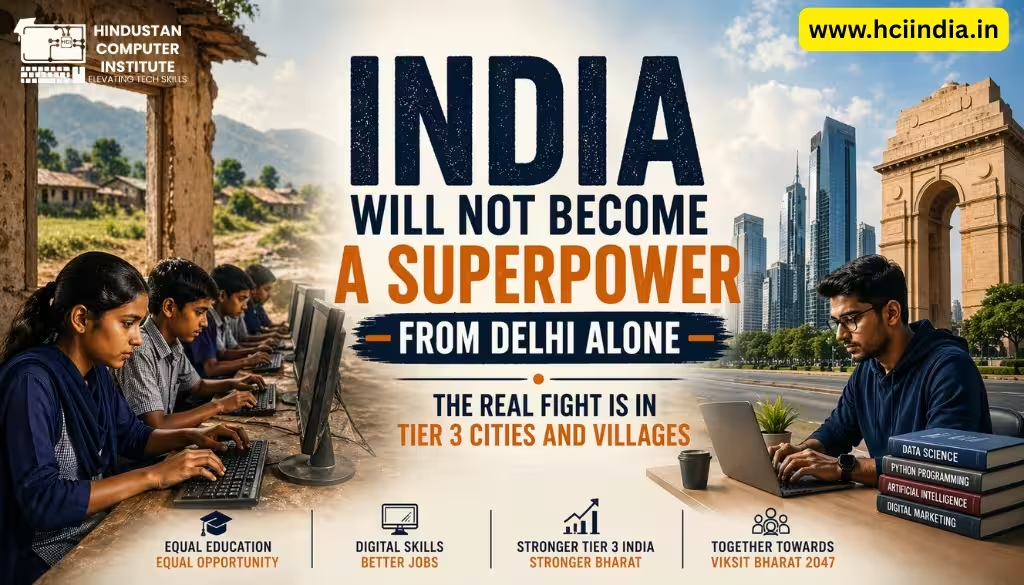
There is something a little dishonest about how we talk about India's future.
We speak about India as an emerging global power. We point to IITs, Infosys, ISRO's moon landing, and our growing startup ecosystem. And all of that is real. But here is what we don't say out loud enough: almost none of it is reaching the child sitting in a government school in a village in Kathua district, or the Class 10 student in a small town in Bihar who has never touched a computer keyboard in his life.
I run a computer institute in Billawar, Jammu & Kashmir - one of those places that doesn't show up in most conversations about India's technology future. And from where I sit, I can tell you exactly what the gap looks like. Not as an abstract policy problem. As a daily reality.
What “Viksit Bharat 2047” Looks Like From a Tier 3 Town
The government's vision of a developed India by 2047 is not wrong. India does have the demographic advantage, the English-speaking workforce, and the technical talent base to compete at the highest levels globally.
But talent is not evenly distributed. Opportunity is not evenly distributed. And right now, the quality of education a child receives is determined almost entirely by the postcode they were born into.
A student in South Delhi has access to coding bootcamps, robotics clubs, and private tutors who can prepare them for the future. A student in Billawar - or in hundreds of similar towns across India - goes to a school where the computer lab may have 10 machines for 200 students, where the “computer teacher” was originally hired to teach something else, and where learning Microsoft Excel is considered advanced technology education.
That gap is not just unfair. It is a waste of human potential that India genuinely cannot afford.
The Numbers Nobody Wants to Talk About
India has over 600,000 villages. More than 65% of the population still lives in rural or semi-urban areas. A large share of these students will complete their schooling and enter adulthood without ever being taught a single skill that directly translates to a job in the modern economy.
Meanwhile, the jobs being created - in IT, accounting software, digital marketing, data entry, financial services - require exactly the kind of computer and digital skills that are systematically absent from rural and Tier 3 education systems.
We are training one half of India for the future and leaving the other half with textbooks written for the past.
The irony is that these are not hard skills to teach. Tally Prime, MS Office, basic coding, AI tools - these can be taught effectively in 6 to 12 months. A student who completes a structured diploma in computer applications can realistically walk into a ₹15,000–₹25,000 per month job. That salary, in a Tier 3 town, changes a family's economic trajectory.
But only if the training actually reaches them.
What Happens When It Doesn’t Reach Them
When quality education doesn't reach Tier 3 cities and villages, a few things happen - and I have watched all of them play out over years of working in this region.
First, students migrate. Every year, young people from smaller towns leave for bigger cities, not because they want to, but because they see no future where they are. Some of them make it. Many of them don't, and come back with nothing to show for it.
Second, the talent gap in local economies widens. Businesses in smaller towns struggle to find even basic computer-literate staff. Accountants who know Tally. Office assistants who can prepare documents and manage spreadsheets. This is not a high bar - but it is one that the local education system consistently fails to clear.
Third, the dependency on a narrow band of “good colleges” and “government jobs” becomes absolute. When there is no skill-based alternative, every family puts everything into clearing an entrance exam or getting a government posting. The pressure is enormous, the success rate is low, and the backup plan doesn't exist.
This is the cycle. And it doesn't break on its own.
J&K Is a Case Study - Both for the Problem and the Possibility
Jammu & Kashmir is an interesting example. It is a region with genuinely bright students, real drive, and families who take education seriously. It is also a region where geography, infrastructure challenges, and historical underinvestment in technical education have created a significant skills gap.
At HCI, we have trained over 2,500 students - most of them from Tier 3 towns and rural backgrounds across J&K. Many of them came in not knowing how to use a mouse properly. Many of them left with job-ready skills and placement support connecting them to companies.
That is not a miracle. That is just what happens when you put decent training infrastructure in front of students who have been waiting for it.
The demand is absolutely there. What has been missing is supply - institutes willing to set up in places like Billawar instead of only in Jammu city or Chandigarh.
What “Matching the National Standard” Actually Means
When I say Tier 3 and rural education needs to match the national standard, I don't mean building IIT campuses in every village. That conversation is a distraction.
What I mean is specific and achievable:
Every student completing Class 10 should be able to type at 30 words per minute, operate MS Office applications, and understand basic internet safety. This is table stakes for the modern job market - and right now, a majority of rural students graduate without these skills.
Every district should have at least one institution offering a structured, industry-aligned diploma in computer applications or financial accounting. Not a “computer training centre” where someone teaches MS Paint. A real program with real curriculum, taught by teachers who actually know the software.
Placement support should be part of the offering - not as a marketing claim, but as a genuine service. Many rural students get the skills but don't know how to convert them into jobs because nobody has taught them how to write a CV, appear for an interview, or navigate a job portal.
These are not grand policy reforms. They are operational things that working institutes can do right now, in the towns and villages where the gap actually exists.
The Economic Logic Is Not Complicated
India's demographic dividend - the much-cited advantage of having a young population - only pays off if that young population is employed and productive.
Right now, we have millions of young people in rural India who are willing to work, capable of learning, and completely cut off from the training infrastructure that would make them employable. That is not a demographic dividend. That is an unfired gun.
The return on investment for skill training in Tier 3 areas is, frankly, higher than almost anywhere else. A student from a city with good schooling might already have some of these skills. A student from a village - when you actually train them - gets a complete step-change in life trajectory. One 12-month course can move a family from subsistence to stability.
Scale that across thousands of towns, and you start to see what India's real economic growth story could look like.
This Is Where HCI Stands
I started Hindustan Computer Institute in Billawar because I grew up understanding exactly what the absence of this kind of institution costs a community. Students who are smart enough, motivated enough, but simply don't have access to what they need.
HCI is ISO 9001:2015 certified, MSME registered, and a Tally and Marg ERP authorized training partner. Not because those certifications are everything, but because they mean something to a parent in a small town who needs to know that the training their child receives is real and recognized.
Our ADCA course - now AI-integrated - covers MS Office, AI tools, cloud basics, and cybersecurity in 12 months. Our ADFA program covers Tally Prime, GST, TDS, and financial software for students heading into accounting roles. And our basic computer course is the starting point for students who are coming in from schools where digital education was essentially absent.
This is not unique to HCI. Every town needs this. The question is whether enough people are willing to build it there.
What to Do Next
India's superpower story will be written in Billawar, Bhagalpur, Belgaum, and thousands of towns like them - or it won't be written at all.
If you are a student or parent in a Tier 3 city, a village, or a region where quality digital education has always felt like something available to someone else - it doesn't have to stay that way.
Book a free counselling session with HCI and find out which course fits your background and goals. We work with students at every level, including those who are starting from scratch. No pressure, no sales pitch - just an honest conversation about what's possible.
You can also explore our full course offering at hciindia.in/courses/ or read more on the HCI knowledge blog.