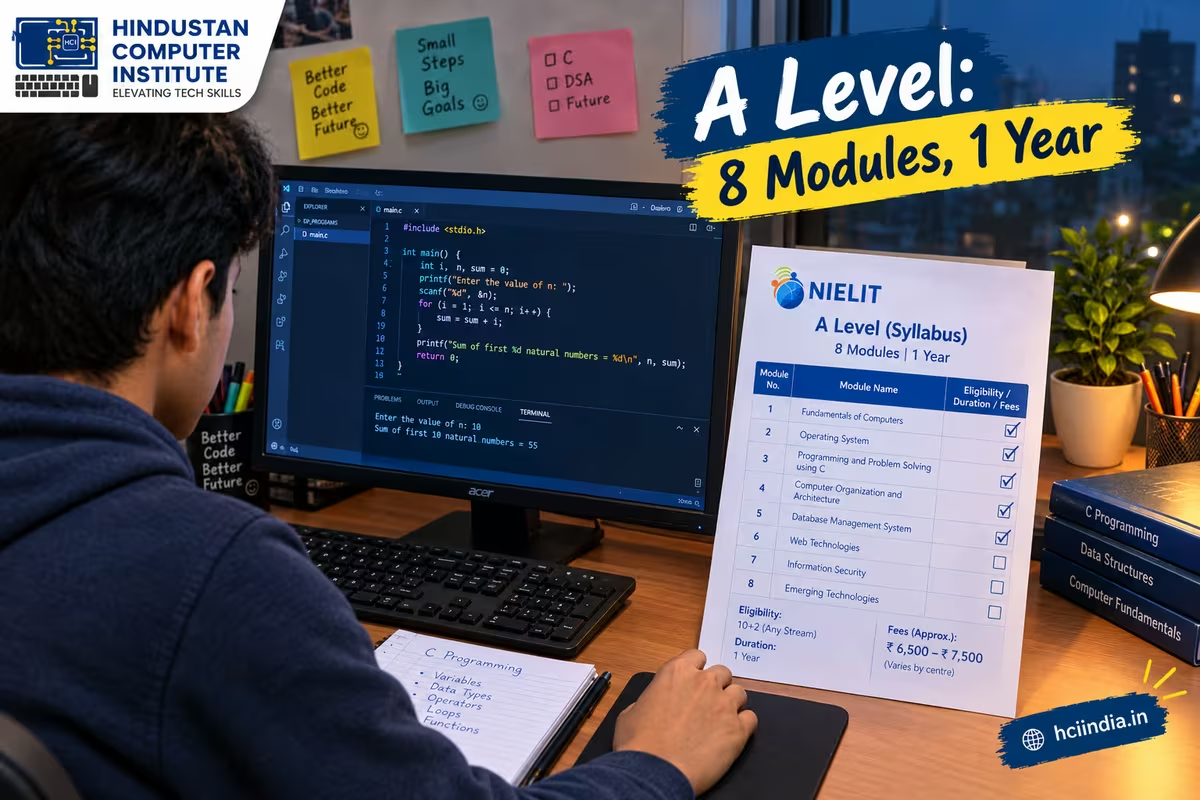
The NIELIT A Level course is a one-year advanced diploma in information technology, taken after O Level or after 10+2 with mathematics. It covers eight theory modules including C programming, Java, DBMS, Unix and artificial intelligence, plus a practical and project component. Total NIELIT charges come to roughly ₹7,000 to ₹9,000.
What is the NIELIT A Level course? (Quick Answer)
A Level sits directly above O Level in NIELIT's graded scheme, and it is treated as an advanced diploma in IT. Several sources describe it as post-graduate diploma equivalent, and it is the level at which NIELIT's certificates start being taken seriously for actual technical work rather than as eligibility paperwork.
It is also, by some distance, the least-known qualification in the ladder. Students who have heard of CCC and O Level frequently have no idea A Level exists, which is a shame, because for the right candidate it is unusually good value.
NIELIT A Level syllabus 2026: all eight modules
| Module | Subject | What it prepares you for |
|---|---|---|
| A1 | IT Tools and Business Systems | Foundation and business application context |
| A2 | Web Technologies and Cloud Developers | Front-end work and cloud fundamentals |
| A3 | Programming Through C Language | Core programming logic and structure |
| A4 | Introduction to Database Management Systems | SQL, data modelling, backend roles |
| A5 | Basics of OS, Unix and Shell Programming | System administration and server work |
| A6 | Data Structures Through C++ | The module that matters for technical interviews |
| A7 | Object Oriented Programming Through Java | Enterprise application development |
| A8 | Artificial Intelligence | Current-generation AI tools and concepts |
Module names and codes follow the current NIELIT scheme [uncertain — NIELIT revises the syllabus periodically and module codes vary between revisions; confirm against the current scheme at student.nielit.gov.in].
That is a real computer science spread. C, C++, Java, SQL, Unix and AI in one year is more technical ground than most private diplomas cover in two.
A Level fees, eligibility and duration
Registration with NIELIT costs around ₹3,000, and each module exam is approximately ₹500, putting the total in the ₹7,000 to ₹9,000 range across the full course including practical and project components [uncertain — verify the current fee schedule on the portal before budgeting].
Eligibility is either a completed O Level certificate, or 10+2 with mathematics or statistics as a subject. That mathematics requirement catches people out, and it is not negotiable, because A Level assumes you can handle the logic that data structures and algorithms demand.
Duration is one year after O Level, which means roughly two years total if you are starting from Class 10 and taking both. Exam cycles run alongside the O Level calendar, in January and July, with registration opening months ahead.
Who should actually do A Level?
A Level is the right course for a specific person, and the wrong one for most.
It suits you if you finished O Level, cleared the Python paper without hating it, and want to work in IT rather than in an office that uses computers. That distinction is the whole thing. A Level teaches you to build software; O Level teaches you to be competent with it.
It suits you if you have 10+2 with mathematics and cannot afford or access a BCA or B.Tech. A Level at under ₹10,000 covering C, Java, DBMS and data structures is a serious technical grounding at a price no degree comes close to, and NIELIT's name on it means employers can verify it.
It does not suit you if you are chasing a clerical or computer operator post. Those notifications name CCC or O Level, and A Level is a year and eight modules of overkill for a form that would have accepted a ₹590 CCC certificate. We have seen students do this and it is painful to watch.
Career scope after A Level
A Level opens junior technical roles rather than office roles, which is a different job market with a different ceiling. Junior developer, database assistant, systems support, technical support and IT assistant positions are the realistic entry points.
Government IT posts that ask for a diploma or advanced diploma in computer applications generally accept A Level, and because NIELIT issues it, verification is straightforward. In the private sector, the qualification gets you an interview and your project work gets you the job, which is true of every technical qualification including degrees.
Junior developer and technical support roles in north Indian towns advertise roughly ₹15,000 to ₹28,000 a month for freshers [uncertain — heavily dependent on city, and on whether you can show working code]. In metros, meaningfully more.
The honest limit: A Level is not a B.Tech, and companies that filter on degree will filter you out regardless of what you can build. What it does is get you past companies that filter on demonstrated skill, and there are more of those than there used to be.
The A6 problem, and how to survive it
Data Structures Through C++ is where A Level candidates stall, and it stalls them for a specific reason. Modules A1 through A5 can be passed by understanding and revising. A6 cannot. Linked lists, trees, sorting and searching only make sense once you have written them yourself and watched them fail.
Students who treat A6 like a theory paper fail it. Students who write every data structure by hand, badly, and then debug it, pass comfortably. There is no third path and no shortcut, and the module is worth planning your entire year around.
Budget more time for A6 than for any two other modules combined. If you are taking the course as a direct candidate without teaching support, this is the module where you should reconsider that and find someone to sit with.
A Level support at Hindustan Computer Institute
We will be straight about scope here: A Level is a specialised course and most of our students are on office-skills and accounting tracks rather than programming ones. What we do offer is counselling on whether A Level fits your goal, the foundation that makes it survivable, and honest redirection when a cheaper certificate would have done. The institute holds ISO 9001:2015 certification and is registered with MSME and the Ministry of Corporate Affairs; 2,500+ students have trained with us from Billawar.
If your goal is office and accounts work rather than software, our dual diploma covering IT and accounting is the closer match and we will say so.
Conclusion
A Level is the most underrated qualification NIELIT offers and the most commonly mis-chosen. Eight technical modules for under ₹10,000 is exceptional value if you want to build software, and a wasted year if you want a government clerical post. Check the mathematics eligibility before anything else, plan your calendar around A6, and be honest about whether you enjoyed programming when you met it at O Level. Visit our Billawar centre or book a free counselling session and we will work out whether A Level is your next step or a detour.