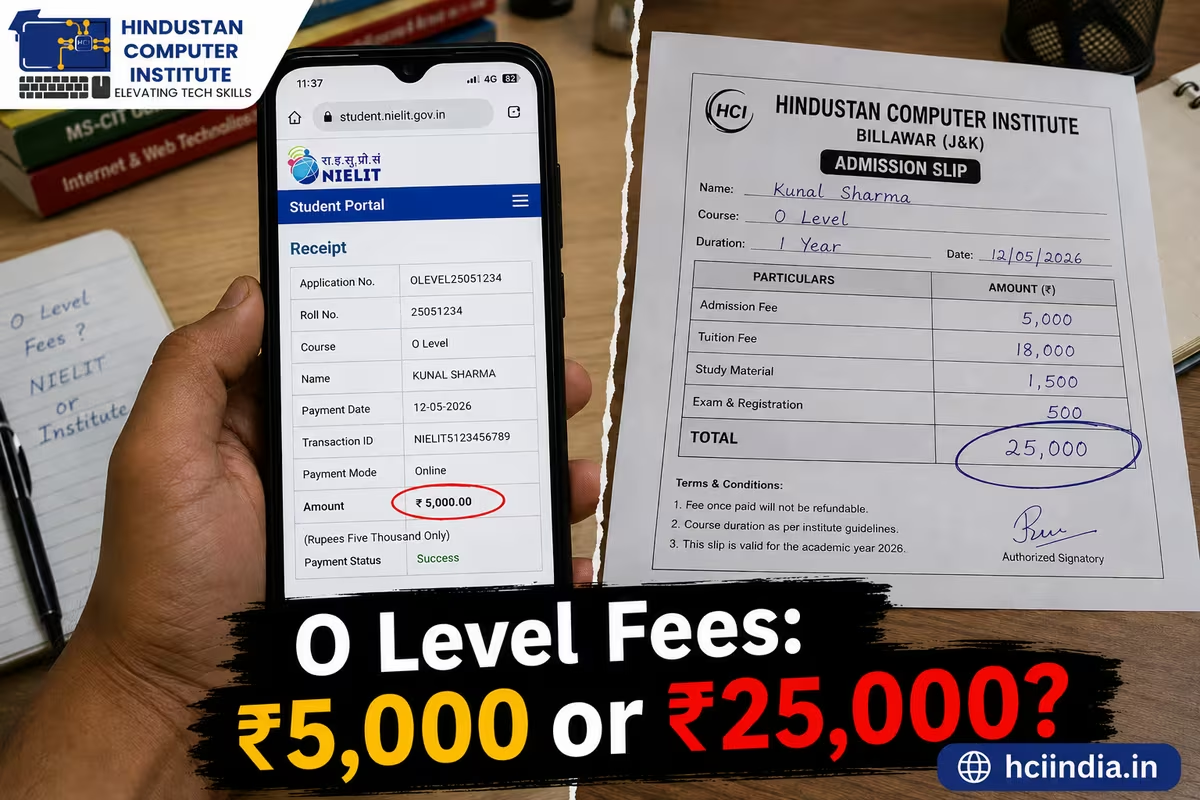
O Level course fees in 2026 split into two routes. Registering directly with NIELIT and paying only the statutory charges works out to roughly ₹4,600 to ₹5,000 across the full course. Enrolling at a private accredited institute usually costs ₹15,000 to ₹25,000, because that figure bundles a year of teaching on top of the same NIELIT fees.
What are O Level course fees in 2026? (Quick Answer)
NIELIT's charges are fixed and published. Registration is ₹500 and stays valid for five years. Each of the four theory papers carries its own exam fee, the practical carries another, and the project carries one more. Add them up and a direct candidate clears the whole course for under ₹5,000.
What a private institute charges on top is teaching, lab access and, if they are any good, someone who has taught Python to beginners before. That is a real service. Whether it is worth ₹20,000 depends entirely on whether you can teach yourself.
NIELIT O Level fee breakdown 2026
| Component | Fee | How often you pay it |
|---|---|---|
| Registration with NIELIT | ₹500 | Once, valid 5 years |
| Theory exam, per paper | ₹750 [uncertain - some sources list ₹1,000] | ×4 papers (M1 to M4) |
| Exam processing fee, per paper | ₹100 | ×4 papers |
| Practical examination | ₹500 [uncertain - ₹300 also reported] | Once |
| Project submission | ₹500 | Once |
| Direct candidate total | ₹4,600 – ₹5,000 | Across the full course |
| Private institute course fee | ₹15,000 – ₹25,000 | Usually two instalments |
Fees marked uncertain are ones where published sources disagree. NIELIT revises these periodically and the portal is the only figure that binds. Check the current schedule at student.nielit.gov.in before you budget, and do not trust a number on any blog, including this one, over the portal itself.
What the four modules actually cover
O Level under the R5 syllabus is four papers, and the spread surprises people who expect an office-software course. M1-R5 is IT Tools and Network Basics, which is the closest thing to familiar ground. M2-R5 is Web Design and Publishing. M3-R5 is Programming and Problem Solving through Python. M4-R5 is Internet of Things and its Applications.
M3 is where students stall. Python is a programming language, and a year of school computer classes does not prepare anyone for writing loops under exam conditions. In our experience, students who came in expecting "advanced MS Office" and met Python in month five are the ones who let their registration lapse. The registration is valid five years, so lapsing is recoverable, but a year of momentum is not.
The course is notionally 540 learning hours across two semesters, with exam cycles in January and July. That pacing is real. If you register in August aiming for the January cycle, you have roughly five months to cover two modules properly.
Where O Level fees pay off, and where they do not
O Level is recognised as equivalent to a foundation-level IT qualification for a range of government recruitment, and for several state posts it satisfies the computer-knowledge requirement that CCC alone does not. That is the real case for it. It sits above CCC and below a formal degree.
The career return depends on which module you take seriously. Students who treated M3 as a hurdle to clear got a certificate. Students who treated Python as a skill got interviews. Junior developer and IT support roles for O Level holders in the north Indian market advertise around ₹12,000 to ₹22,000 a month for freshers [uncertain - varies significantly by city and whether you have a portfolio].
If your goal is a government clerical post rather than an IT job, ask yourself seriously whether you need O Level at all. A 12-month advanced diploma in computer applications covers office automation, AI tools and cybersecurity without the Python and IoT papers, and for a lot of students that is the better match. We say this to prospective O Level students regularly and occasionally talk ourselves out of an admission.
Registering direct: what you are taking on
Saving ₹15,000 by registering direct is real money, and for the right candidate it is the correct decision. It also transfers four jobs onto you that an institute would otherwise handle.
You track the calendar yourself. Exam cycles run in January and July, and the registration windows open months ahead. Miss one and you wait six months, which is how a one-year course quietly becomes a two-year one.
You choose your own exam centre and confirm it is running your papers in that cycle. Not every accredited centre offers every module every time.
You build the project alone. M4 and the project submission carry real weight, and there is no marking rubric published in a form that makes it obvious what an examiner wants. Students who have seen a few submissions have a large advantage here over students who have seen none.
And you teach yourself Python. This is the one that decides it. If you have written code before, in any language, M3 is a syllabus you can work through with a book and a compiler. If you have not, you will spend two months discovering that reading about loops and writing loops are unrelated activities.
Our rule of thumb: if you can already write a working program that takes input and produces output, register direct and save the money. If you cannot, the teaching fee is buying you the one thing you cannot get from the portal.
Why study for O Level at Hindustan Computer Institute?
For an exam like O Level, the only thing worth paying an institute for is supervised lab time on M3 and M4. Python and IoT are the two papers where reading a book does not transfer, and a lecture-only batch will leave you exactly as stuck as self-study would have. Our sessions are hands-on for that reason. We are ISO 9001:2015 certified and registered with MSME and the Ministry of Corporate Affairs, and 2,500+ students have come through our Billawar centre, with online batches open to students elsewhere in India.
We also do not present the NIELIT fees as part of our course fee. They are yours to pay, directly, and we will walk you through the portal.
Conclusion
Work out which candidate you are before you pay anyone. If you can hold yourself to a study schedule and teach yourself Python, register direct with NIELIT and finish O Level for under ₹5,000. If you know you will need teaching, pay for teaching, but ask exactly how many supervised hours you get on M3 before you hand over ₹20,000. Call our Billawar centre or book a free counselling session and we will map your background against the four modules. If O Level turns out to be the wrong course for what you want, we will say so.