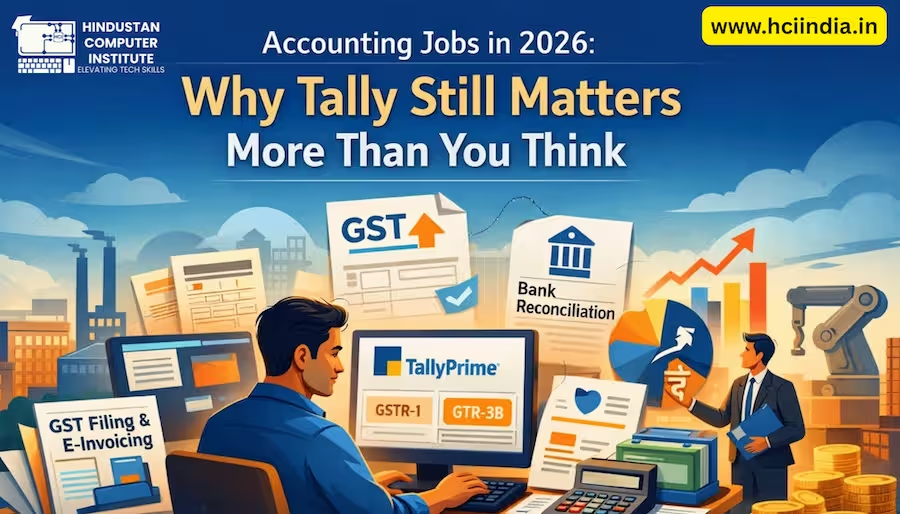
Accounting Jobs in 2026: Why Tally Still Matters More Than You Think
Something has quietly shifted in how Indian businesses hire for accounts roles. Three or four years ago, a candidate who knew basic bookkeeping and could handle Excel reasonably well had decent prospects. That bar has moved — and it has moved fast.
Today, if you apply for an accountant position at almost any GST-registered business — a trading firm, a CA office, a manufacturing unit, a retail chain — the first question on the shortlisting checklist is usually the same: Do you know Tally?
This is not going away. If anything, it is getting more specific.
What Employers Actually Want in 2026
We track job postings for accounting roles across India — everything from entry-level data entry positions to senior finance profiles. The pattern that keeps showing up is this: employers want people who can handle compliance work, not just record transactions.
Here is what comes up constantly in current job descriptions:
- TallyPrime with GST filing — not just knowing the software, but actually filing GSTR-1, GSTR-3B, reconciling GSTR-2A, and handling e-invoicing
- TDS and payroll — deduction management, PF, ESI, Form 16 basics
- Bank reconciliation — a surprisingly large number of firms still struggle with this and actively look for people who can manage it without supervision
- Basic Excel for MIS reporting — not pivot tables necessarily, but structured reports that a manager can read and act on
The entry point has shifted. You are not competing with people who do not know software. You are competing with people who do — and some of them also have GST filing experience. That is the real job market in 2026.
Where Tally Fits
There are larger, more expensive ERP systems — SAP, Oracle, Zoho Books — used by bigger companies. But Tally dominates the mid-market and SME segment in India, which is where most accounting jobs actually exist. India has tens of millions of registered businesses. The vast majority of them use Tally.
TallyPrime, the current version, has also closed the gap with cloud tools. It now supports remote access, real-time data sync across branches, and AI-assisted ledger suggestions. It integrates directly with the GST portal and handles e-way bills and e-invoicing natively.
So when people say "Tally is old" or "Tally is being replaced by cloud software" — that has not actually happened in the segment where most accountants work. TallyPrime is actively developed and deeply embedded in India's compliance infrastructure. Learning it properly is still one of the most direct routes into an accounting job.
The Skills That Set You Apart
Basic Tally knowledge gets you in the door. What pushes your salary up is the combination skills.
In our experience placing students with employers, the candidates who get better offers are the ones who can say: "I know Tally, I can file GST returns, I can handle payroll, and I can generate a clean P&L statement without hand-holding." That combination — even without a degree in commerce or accounting — routinely gets candidates into roles paying ₹20,000 to ₹35,000 per month at entry level, with room to grow quickly.
After two to three years of experience, those figures often look like ₹35,000 to ₹60,000. Senior accountants handling compliance and audit work independently clear ₹80,000 and above, especially in metro cities.
These are not inflated numbers. They reflect what employers in our placement network are currently paying.
A Practical Note on Automation
There is a lot of noise right now about AI replacing accounting jobs. Worth addressing this directly.
What automation has actually done, so far, is reduce demand for people whose only skill is data entry — punching numbers into a system. That work is shrinking. But accounts verification, GST compliance, financial analysis, audit preparation, payroll management — all of that still needs trained humans, partly because the rules keep changing and partly because someone has to be responsible when there is an error.
The accountants who are struggling are the ones who resisted digital tools. The ones who are doing well are the ones who learned those tools and moved up into oversight and analysis work. That transition is available to anyone willing to spend a few months building the right skill set.
What We Teach at HCI India
At Hindustan Computer Institute as an Authorised Training Partner of Tally our accounting courses runs 3 months to 1 year depending on the track you choose. We cover TallyPrime from the ground up — company creation, accounting vouchers, inventory management, GST, payroll, TDS, and financial reports.
Students work through real business scenarios, not textbook exercises. By the time you finish, you have handled a simulated business's complete accounts cycle — from opening balances to balance sheet. That hands-on approach is what makes our certification credible with employers.
We also provide placement support. We work with CA firms, manufacturing companies, and trading businesses that hire our students. If you are a fresh commerce student or a working professional looking to make a move into accounting, a structured course is a much faster route than self-study — and it comes with a credential that employers recognise.
If You Are Thinking About Starting
The best time to have started was a year ago. The second best time is now.
Businesses are not slowing down their digital accounting adoption. Every month you wait, the gap between what employers expect and what you currently offer gets a little wider. Six months of focused training — done right — can close that gap entirely and put you in a position to compete for real accounting roles.
If you want to understand what the course covers or talk through whether it is the right fit for where you are right now, book a free career counselling session.