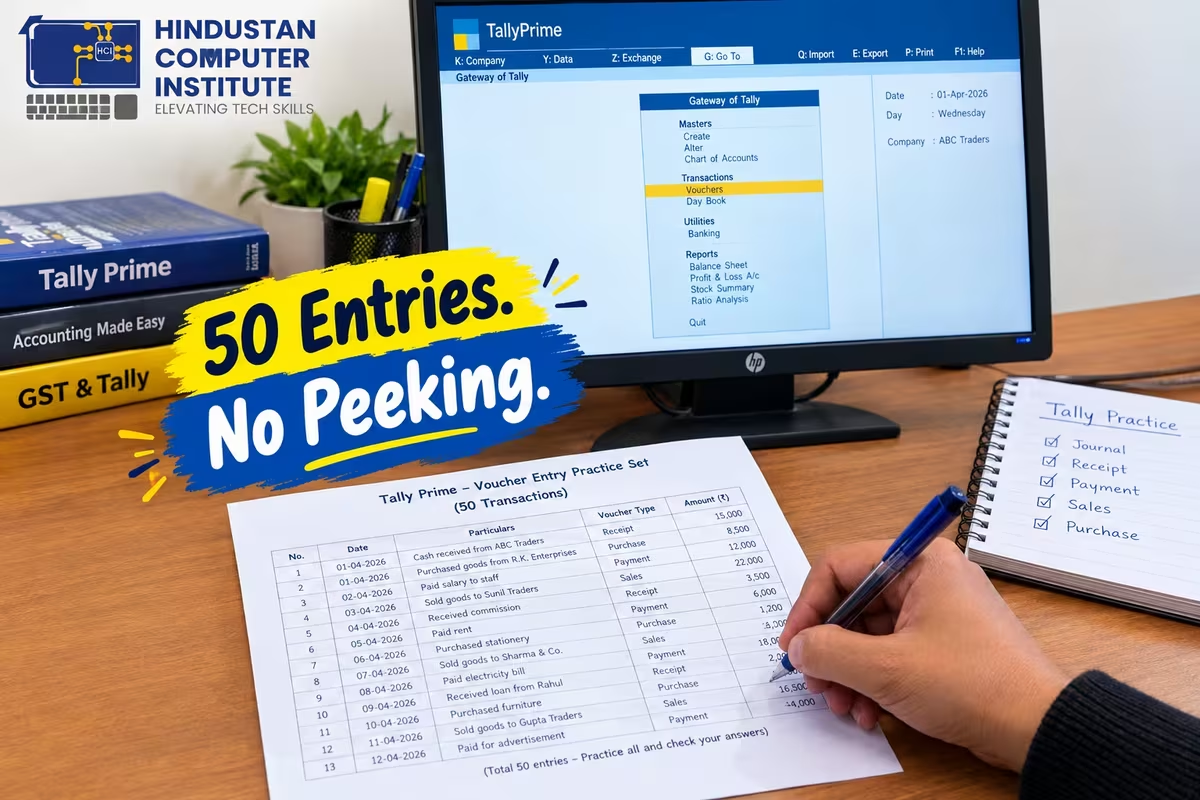
Below are 50 practice transactions covering every voucher type in Tally Prime: purchase, sales, payment, receipt, contra, journal, debit note and credit note. Each one shows the correct voucher type and the debit and credit entry. Cover the answer column, do the entry yourself, then check.
How to use this Tally practice set
Reading entries teaches you nothing. That sounds harsh and it is the single most common reason students fail practical interviews after passing a Tally course.
Open Tally Prime, create a company called Practice Ltd, and actually enter these. When your Balance Sheet does not tally at the end, that is the point of the exercise. Finding your own mistake teaches you more than fifty correct entries copied down.
Set aside three sittings of about an hour. Entries 1 to 20 are the basics, 21 to 38 add GST and adjustments, and 39 to 50 are the ones that appear in interviews.
Part 1: Basic entries (1–20)
| # | Transaction | Voucher | Entry |
|---|---|---|---|
| 1 | Started business with cash ₹5,00,000 | Receipt | Dr Cash 5,00,000 / Cr Capital A/c 5,00,000 |
| 2 | Opened bank account, deposited ₹2,00,000 | Contra | Dr Bank 2,00,000 / Cr Cash 2,00,000 |
| 3 | Purchased goods for cash ₹50,000 | Purchase | Dr Purchase 50,000 / Cr Cash 50,000 |
| 4 | Purchased goods from Sharma Traders on credit ₹80,000 | Purchase | Dr Purchase 80,000 / Cr Sharma Traders 80,000 |
| 5 | Sold goods for cash ₹40,000 | Sales | Dr Cash 40,000 / Cr Sales 40,000 |
| 6 | Sold goods to Verma Stores on credit ₹1,20,000 | Sales | Dr Verma Stores 1,20,000 / Cr Sales 1,20,000 |
| 7 | Paid rent ₹15,000 by cash | Payment | Dr Rent 15,000 / Cr Cash 15,000 |
| 8 | Paid salary ₹35,000 by cheque | Payment | Dr Salary 35,000 / Cr Bank 35,000 |
| 9 | Received ₹60,000 from Verma Stores | Receipt | Dr Cash 60,000 / Cr Verma Stores 60,000 |
| 10 | Paid ₹50,000 to Sharma Traders by cheque | Payment | Dr Sharma Traders 50,000 / Cr Bank 50,000 |
| 11 | Purchased furniture ₹45,000 by cheque | Payment | Dr Furniture 45,000 / Cr Bank 45,000 |
| 12 | Paid electricity bill ₹4,200 | Payment | Dr Electricity Expenses 4,200 / Cr Cash 4,200 |
| 13 | Withdrew ₹20,000 from bank for office use | Contra | Dr Cash 20,000 / Cr Bank 20,000 |
| 14 | Owner withdrew ₹25,000 for personal use | Payment | Dr Drawings 25,000 / Cr Cash 25,000 |
| 15 | Paid carriage inward ₹3,000 on goods purchased | Payment | Dr Carriage Inward 3,000 / Cr Cash 3,000 |
| 16 | Paid carriage outward ₹2,500 on goods sold | Payment | Dr Carriage Outward 2,500 / Cr Cash 2,500 |
| 17 | Purchased stationery ₹1,800 | Payment | Dr Printing and Stationery 1,800 / Cr Cash 1,800 |
| 18 | Received commission ₹8,000 | Receipt | Dr Cash 8,000 / Cr Commission Received 8,000 |
| 19 | Paid insurance premium ₹12,000 by cheque | Payment | Dr Insurance Premium 12,000 / Cr Bank 12,000 |
| 20 | Took bank loan ₹3,00,000 credited to bank | Receipt | Dr Bank 3,00,000 / Cr Bank Loan 3,00,000 |
Part 2: GST and adjustment entries (21–38)
| # | Transaction | Voucher | Entry |
|---|---|---|---|
| 21 | Purchased goods ₹1,00,000 + 18% GST (intra-state) on credit | Purchase | Dr Purchase 1,00,000, Dr Input CGST 9,000, Dr Input SGST 9,000 / Cr Supplier 1,18,000 |
| 22 | Sold goods ₹1,50,000 + 18% GST (intra-state) on credit | Sales | Dr Customer 1,77,000 / Cr Sales 1,50,000, Cr Output CGST 13,500, Cr Output SGST 13,500 |
| 23 | Purchased goods ₹80,000 + 18% IGST (inter-state) | Purchase | Dr Purchase 80,000, Dr Input IGST 14,400 / Cr Supplier 94,400 |
| 24 | Sold goods ₹60,000 + 5% GST (intra-state) for cash | Sales | Dr Cash 63,000 / Cr Sales 60,000, Cr Output CGST 1,500, Cr Output SGST 1,500 |
| 25 | Returned goods worth ₹10,000 to supplier (no GST shown) | Debit Note | Dr Supplier 10,000 / Cr Purchase Return 10,000 |
| 26 | Customer returned goods worth ₹15,000 | Credit Note | Dr Sales Return 15,000 / Cr Customer 15,000 |
| 27 | Paid GST liability ₹22,000 by cheque | Payment | Dr Output CGST/SGST 22,000 / Cr Bank 22,000 |
| 28 | Depreciation on furniture ₹4,500 | Journal | Dr Depreciation 4,500 / Cr Furniture 4,500 |
| 29 | Rent outstanding for the month ₹15,000 | Journal | Dr Rent 15,000 / Cr Outstanding Rent 15,000 |
| 30 | Insurance prepaid ₹3,000 | Journal | Dr Prepaid Insurance 3,000 / Cr Insurance Premium 3,000 |
| 31 | Bad debts written off ₹7,000 | Journal | Dr Bad Debts 7,000 / Cr Customer 7,000 |
| 32 | Discount allowed to customer ₹2,000 at time of receipt | Receipt | Dr Cash 48,000, Dr Discount Allowed 2,000 / Cr Customer 50,000 |
| 33 | Discount received from supplier ₹1,500 at time of payment | Payment | Dr Supplier 30,000 / Cr Bank 28,500, Cr Discount Received 1,500 |
| 34 | Interest on bank loan ₹9,000 debited by bank | Journal | Dr Interest Paid 9,000 / Cr Bank 9,000 |
| 35 | Bank charges ₹350 debited | Journal | Dr Bank Charges 350 / Cr Bank 350 |
| 36 | Goods worth ₹5,000 taken by owner for personal use | Journal | Dr Drawings 5,000 / Cr Purchase 5,000 |
| 37 | Goods worth ₹3,000 destroyed by fire, no insurance | Journal | Dr Loss by Fire 3,000 / Cr Purchase 3,000 |
| 38 | Salary payable for the month ₹35,000 | Journal | Dr Salary 35,000 / Cr Salary Payable 35,000 |
Part 3: The interview entries (39–50)
These twelve come up disproportionately often in practical interviews. If you can do these without hesitating, you are ready.# Transaction Voucher Entry 39 Cheque received from customer ₹40,000, deposited same day Receipt Dr Bank 40,000 / Cr Customer 40,000 40 Cheque of ₹40,000 dishonoured by bank Journal Dr Customer 40,000 / Cr Bank 40,000 41 Advance received from customer ₹25,000 against future supply Receipt Dr Cash 25,000 / Cr Advance from Customer 25,000 42 Advance paid to supplier ₹30,000 Payment Dr Advance to Supplier 30,000 / Cr Bank 30,000 43 TDS deducted ₹5,000 on professional fees of ₹50,000 Journal Dr Professional Fees 50,000 / Cr TDS Payable 5,000, Cr Party 45,000 44 Purchased computer ₹60,000 + 18% GST for office use Purchase Dr Computer 60,000, Dr Input CGST 5,400, Dr Input SGST 5,400 / Cr Supplier 70,800 45 Cash sales ₹18,000, deposited into bank same day Sales + Contra Sales: Dr Cash / Cr Sales 18,000. Contra: Dr Bank / Cr Cash 18,000 46 Input GST adjusted against output GST at month end ₹18,000 Journal Dr Output CGST/SGST 18,000 / Cr Input CGST/SGST 18,000 47 Provision for tax created ₹40,000 Journal Dr Profit and Loss 40,000 / Cr Provision for Tax 40,000 48 Closing stock valued at ₹95,000 Journal Dr Closing Stock 95,000 / Cr Trading A/c 95,000 49 Loan repaid ₹50,000 with ₹4,000 interest by cheque Payment Dr Bank Loan 50,000, Dr Interest Paid 4,000 / Cr Bank 54,000 50 Cash found short by ₹500 during physical verification Journal Dr Cash Shortage 500 / Cr Cash 500
Entry amounts and treatments follow standard practice [uncertain — GST rates and TDS rates change; apply the rate current at your transaction date, and confirm treatment with your accountant for real books].
The five entries students get wrong most often
Entry 40, the dishonoured cheque, catches almost everyone. Students reverse the original receipt instead of debiting the customer again. The customer owes the money once more, so the customer is debited. Think about who owes whom rather than about undoing a transaction.
Entry 36, goods taken by the owner, gets posted as a sale by roughly half our batch on first attempt. It is not a sale. Nothing was sold and no profit arose. Purchase is credited because the goods left the business without becoming revenue.
Entry 45 is a trap because it looks like one transaction and is two. Cash sales happened, then cash moved to bank. Students who post it directly as Dr Bank / Cr Sales lose the cash-book trail, and an auditor will notice.
Entry 43, TDS, confuses people because three accounts are involved and the party gets less than the expense. The expense is the full ₹50,000. The party receives ₹45,000. The ₹5,000 is held to be deposited with the government.
Entry 32 and 33, discounts, get reversed. Discount allowed is your expense because you gave it away. Discount received is your income because you kept it. If you are unsure which group these belong in, our full ledger and group lookup list covers all of them.
What to do after you finish all 50
Print your Trial Balance, Profit and Loss, and Balance Sheet. If the Balance Sheet does not balance, do not restart. Find the entry.
The usual culprits are a ledger placed in the wrong group, a GST amount posted to the wrong side, or a journal entry where debit and credit do not match. Tally will not always stop you from making these, which is precisely why interviews test them.
Once the books balance, do it again from scratch without the answer column. The second run is where the learning actually sticks. Then move on to GST return filing, because entries alone will not get you the better offer, as we set out in our breakdown of what Tally actually pays.
Download the practice set PDF
The PDF contains all 50 transactions as a blank worksheet you can print, plus the full solution sheet, plus a one-page ledger-to-group reference. Enter your name and WhatsApp number and we will send it across at no charge.
[INSERT GATED PDF FORM BLOCK: name + WhatsApp number, routed into the Day 0/1/3/7/14 admissions sequence]
How we run practice sets at HCI
Every accounting batch at our Billawar centre does a set like this before the course ends, on a machine, timed, with the answer sheet face down. Students who breeze through the theory frequently stall at entry 40, and that is the most useful hour of the whole course.
We are a Tally Authorized Training Partner and registered with Marg ERP, ISO 9001:2015 certified, and registered with MSME and the Ministry of Corporate Affairs. 2,500+ students trained from Billawar, with online batches for students elsewhere.
Conclusion
Fifty entries is roughly three hours of work and it is the difference between saying you know Tally and showing it. Do them on a keyboard, not on paper. Get the Balance Sheet to balance. Then do the twelve interview entries again until they are automatic, because those are the ones you will be asked to do in front of someone. Bring your practice file to our Billawar centre and we will go through your mistakes with you, or book a free counselling session to find out which module you still need.