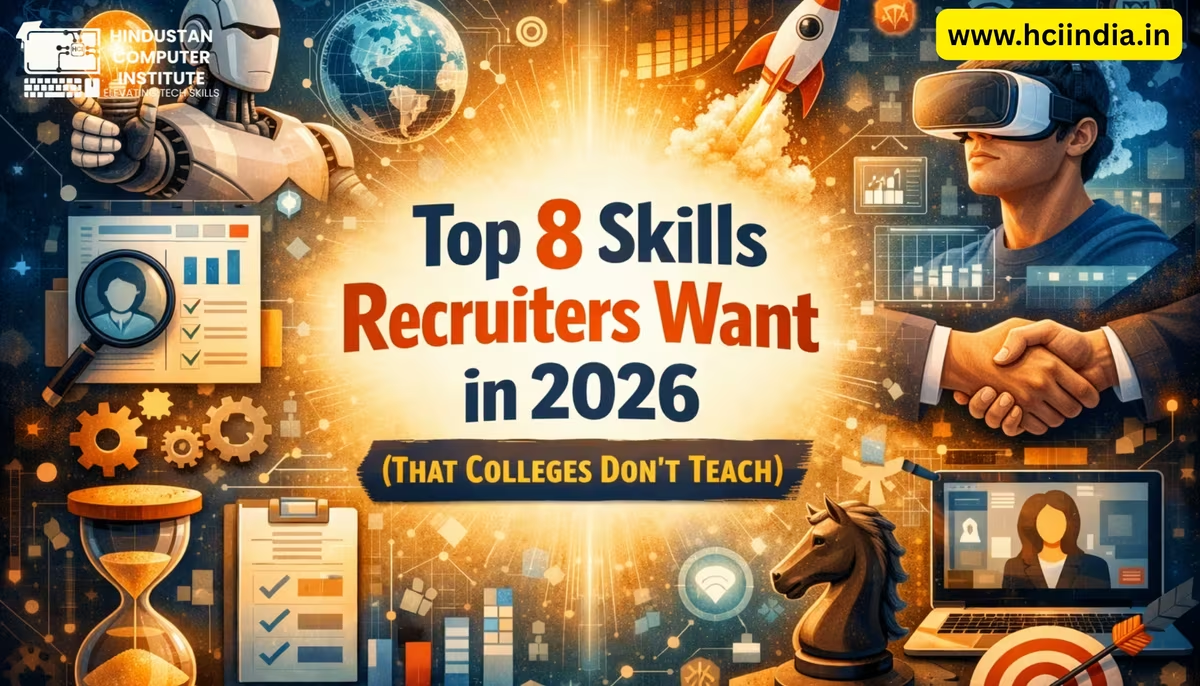
Top 8 Skills Recruiters Want in 2026 That Your College Probably Never Taught You
Here is something nobody tells you at your convocation: a degree alone is no longer enough. Across India, eight out of ten employers now hire based on skills first and degrees come later. If you are a fresher stepping into placements this year, that single fact changes everything about how you should prepare.
A June 2025 Economic Times report found that even students from elite colleges the ones with recognizable names in Instagram bios saw only 15 to 30% of their batch getting placed. Not because jobs dried up. Companies simply looked at these candidates and found no clear proof that they could perform. Great marks, famous institution, zero demonstrable skill.
The good news? This shift is actually an opportunity for you, especially if you are willing to act on it right now.
Quick Answer: The top skills recruiters prioritise in 2026 are AI and digital fluency, practical proof of work, business communication, problem-solving, remote work readiness, cross-cultural collaboration, data-driven self-presentation, and a genuine curiosity to learn. These are learnable skills and the right computer course can get you there faster than you think.
About This Blog: What You Will Learn Here
Before we get into the list, here is a short overview of what this article covers. We have pulled insights from the Economic Times, India Skills Report, Michael Page India Survey, and VBox India Skills Report 2025 and translated them into concrete steps you can take starting today.
Whether you are a student in Billawar, Jammu, or anywhere across India, this article will show you exactly where the hiring game is headed and what you can do about it before your next interview.
Skill 1: AI and Digital Fluency - The New Minimum Standard
Let us start with the one that surprises most students the most. Recruiters do not expect freshers to be software engineers or data scientists. What they do expect is basic comfort with technology.
According to the VBox India Skills Report 2025, about 45% of employers now prioritise digital fluency and AI readiness in freshers - even for non-technical roles. HR teams, marketing executives, accounts staff, operations coordinators - all of them are now expected to work with tools that speed up workflows and reduce manual effort.
Think tools like MS Excel with automation, Google Workspace, AI writing assistants, basic data dashboards, and cloud platforms. None of this requires a computer science degree. It just requires deliberate practice.
Students who join HCI's ADCA course (AI Integrated) spend 12 months working hands-on with exactly these tools - MS Office, AI applications, cloud basics, and cybersecurity fundamentals. Students who complete it often tell us that walking into an interview and being able to say "yes, I use these tools regularly" changes the entire tone of the conversation.
Pick three digital tools relevant to your target field. Learn them. Build one small project each. Even a basic automated spreadsheet or a simple dashboard is proof enough.
Skill 2: Proof of Work Over Pedigree
The second shift is the one that levels the playing field most dramatically. Indian companies have officially moved away from degree obsession.
Business Standard's coverage of the Indeed Skills First Report put it plainly: 80% of Indian employers now give more weight to practical skills than to your degree or college name. Recruiters want to know whether you can do the job not what is printed on your marksheet.
This is why students from Tier 2 and Tier 3 cities are increasingly getting hired at the same companies as metro college graduates. The difference is not geography anymore. It is evidence. One strong project, one real internship, one competition win these outrank a semester of classroom theory.
For freshers starting from smaller towns across J&K, Punjab, and other regions, this is genuinely encouraging. If you build real skills and document your work, the playing field is flatter than it has ever been.
Skill 3: Business Communication The Skill 67% of Engineering Graduates Lack
Here is a number that should make you pause. According to the India Skills Report, over 67% of engineering graduates struggle with basic business communication. That means they cannot write a professional email clearly, cannot explain their own work in a presentation, and cannot hold a structured conversation about their ideas.
The Michael Page India Survey backs this up: 37% of hiring managers say communication is the very first thing they evaluate in a candidate not your CGPA, not your college rank.
Communication skills include spoken clarity, writing, active listening, and the ability to adapt your tone for different audiences. These are trained behaviours, not natural gifts. Every group project, every club role, every college event you organise builds this muscle.
At HCI, trainers like Himani Sharma specifically focus on helping students communicate their work confidently whether it is presenting a project or navigating a job interview. It is one of those things that looks small on paper but makes an enormous difference in the room.
Skill 4: Problem-Solving and a Growth Mindset
This one has been on every recruiter's wishlist for years, and it is still the most consistently cited skill in hiring studies including the Times of India's 2025 Employability Report, which listed it as the number one trait companies look for.
What do recruiters actually mean by problem-solving? Not textbook exercises. Real-life, unpredictable situations where instructions are incomplete, the answer is not obvious, and someone needs to take initiative.
Alongside this sits what hiring managers call a growth mindset the belief that skills can be built, and the habit of learning rather than freezing when something feels unfamiliar. Companies know that job roles will keep changing because of AI and automation. They want freshers who can adapt, not just execute.
The practical takeaway here is simple. Start collecting stories. Every time you handled a tricky situation, every time you figured something out without being told those are interview answers in waiting. Write them down. Structured thinking, practised deliberately, becomes a real skill over time.
Skill 5: Remote and Hybrid Work Readiness
India is moving toward nearly 30 million remote and hybrid roles, according to the VBox India Skills Report 2025. That is not a niche statistic it means a very real chance that your first job involves a distributed team, asynchronous communication, and no one looking over your shoulder to check if you are on track.
Recruiters cannot always test this directly in an interview, so they look for signals. Do you take ownership of tasks? Do you communicate progress clearly without being asked? Do you manage your time without someone chasing you? These questions show up in how you describe your internship experience, how you handle online assessments, and how you interact during virtual interview rounds.
The answer is not to pretend you have remote experience if you do not. It is to start practising these habits right now in college projects, in part-time work, anywhere you are given a task and trusted to deliver it.
Skill 6: Competing in a Nationwide Talent Pool
One thing that catches many freshers off guard is how wide their actual competition is. Ten years ago, placements were largely local your competition was the 50 students in your class. Today, companies hire from across India, and digital-first hiring means a student from Billawar is competing with one from Bengaluru.
According to the India Skills Survey 2024, Tier 2 and Tier 3 cities are producing graduates who are just as employable as metro students and in some fields, more so. The problem is not talent. It is visibility and network.
This makes early networking more important than most students realise. Connect with alumni. Participate in competitions. Join online communities in your field. Show up in spaces where recruiters can find you. One relevant connection or one well-timed referral can shift your career trajectory faster than almost anything else.
Skill 7: A Resume and Profile That Performs in Data-Driven Hiring
Seventy-two percent of recruiters consider "quality of hire" their most important success metric, according to an Economic Times HR Tech report. And to measure that, they use structured assessments, online tests, and skills-based screening not gut feeling.
What this means for you is that your resume and your digital presence are filtered before a human ever sees them. If your resume is cluttered, vague, or poorly formatted, you lose points before the process even begins.
Write crisp, quantified bullet points. "Managed social media accounts" is weak. "Grew Instagram engagement by 40% over three months for a local business" is strong. Every line on your resume should answer the question: so what?
This is where students who have done structured courses have a real edge. They have something concrete to write about - software they have used, projects they have completed, certifications they have earned. The MDCAA course at HCI is specifically built to give students both IT and accounting competencies, which makes for a much richer resume than a general degree alone.
Skill 8: Curiosity and Entrepreneurial Spirit - The X Factor Recruiters Cannot Ignore
The last skill on this list is the hardest to fake and the most powerful when it is genuine. Recruiters call it different things - curiosity, initiative, ownership, entrepreneurial spirit - but they are all pointing at the same thing. Students who do not wait to be told. Students who explore things on their own, try new tools without being forced, and build things even when no one asked them to.
Hiring studies highlighted in the Times of India's 2025 Employability Report show that recruiters consistently value attitude and willingness to learn more than marks. Students with small side projects, club initiatives, or self-driven learning paths regularly outperform higher scorers in interview rounds.
Entrepreneurial spirit here does not mean you need to launch a startup. It means: did you build something? Organise something? Figure something out that no one taught you? A small website, a college event, a research summary, a Notion dashboard - these things signal that you are the kind of person who takes charge. And that signal matters.
What This Means If You Are Starting Your Skill Journey Right Now
If you are reading this and feeling like you are behind, you are not. Most freshers across India are starting from roughly the same point. The difference between those who get placed and those who wait is not talent - it is action taken in the months before the interview season begins.
At HCI, we have trained over 2,500 students - many of them freshers from J&K, Punjab, and other Tier 2 regions who came in with no prior computer background and left with real, demonstrable skills. Our ADFA course covers Tally Prime, GST, TDS, and financial accounting tools that are directly asked for in job listings. Our ADCA course integrates AI tools, cybersecurity basics, and cloud applications into every module. And for complete beginners, our Basic Computer Course is the right entry point.
The job market in 2026 is not waiting. But neither are the opportunities if you move now.
What to Do Next
The eight skills listed here are not abstract qualities. They are learnable, and they are teachable - and the earlier you start, the stronger your placement prospects become.
Thinking about building job-ready skills before your placements begin? HCI's courses are designed exactly for this moment. Whether you are just starting out or looking to add a recognised qualification to your profile, our senior counsellors will help you identify the right programme for your goals and timeline.
👉 Book a free counselling session - no pressure, no sales pitch. Just an honest conversation about what makes sense for you.
You can also explore the full list of HCI courses here or browse our knowledge blog for more career and skill-building guidance.
Hindustan Computer Institute (HCI) is an ISO 9001:2015 certified training institution, MSME and MCA registered with the Government of India, and an authorised Tally and Marg ERP training partner. With 2,500+ students trained and 100% placement assistance, HCI helps freshers across India build the skills that today's job market actually demands.